Categories
Contextualised Practice Contextualised Practice: Project Level 5

Contextualised Practice: Riso Printing

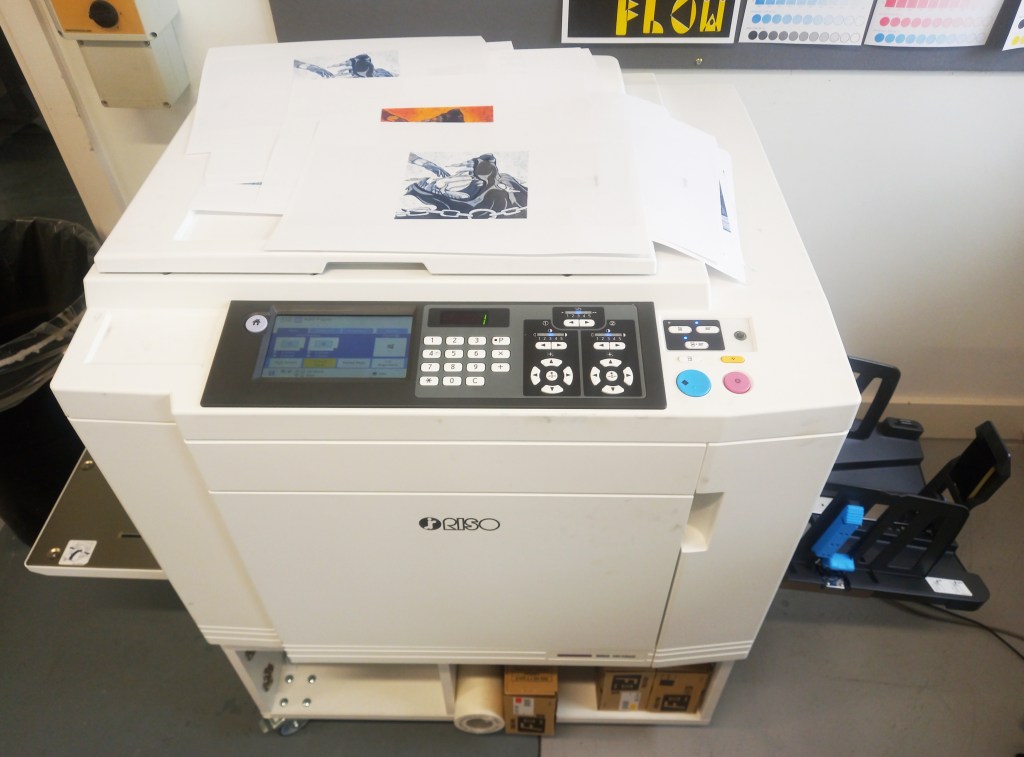
Photos from printing studio session: I booked a day in the printing studio to create my Riso prints. Before the session I prepared all the colour separations I needed as greyscale PDFs. Due to time constraints I chose only 2 illustrations to print, ‘Binding of Fenrir’ and ‘Ragnarok’.
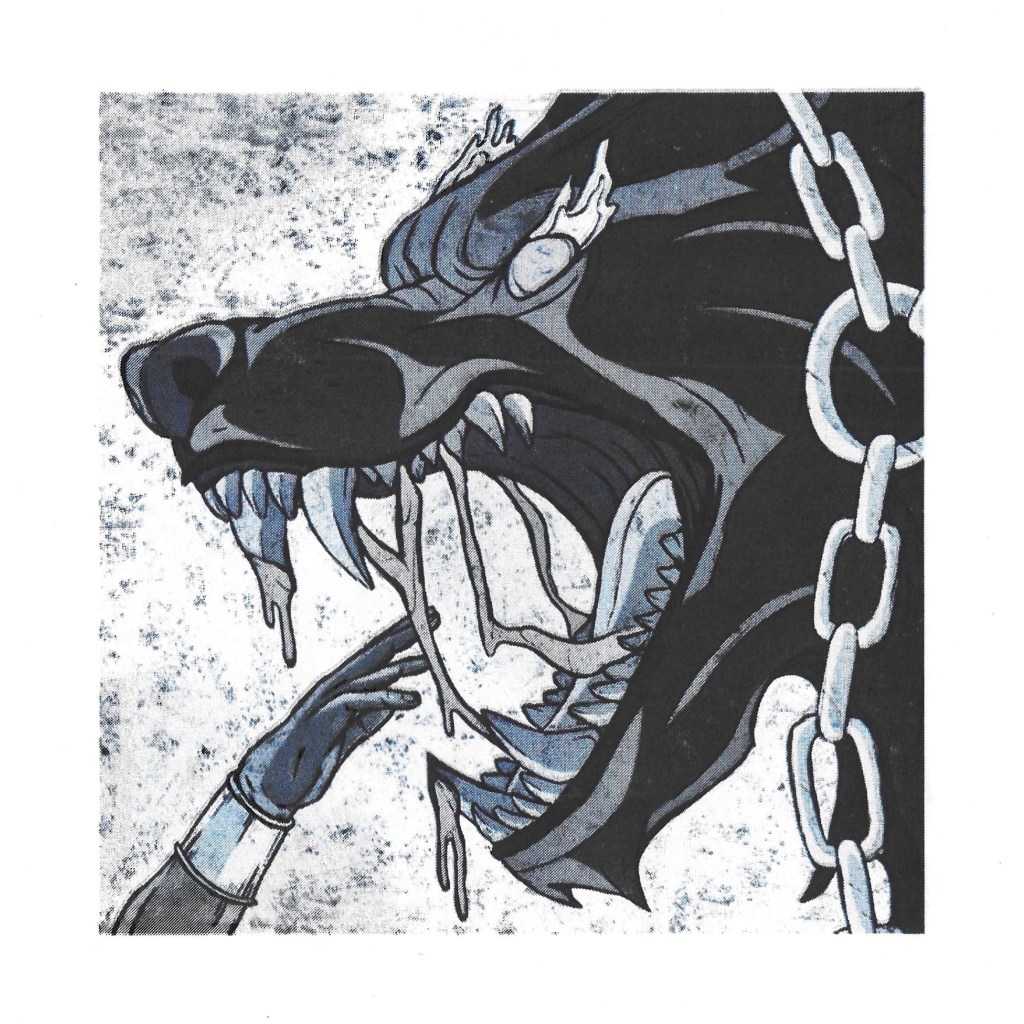
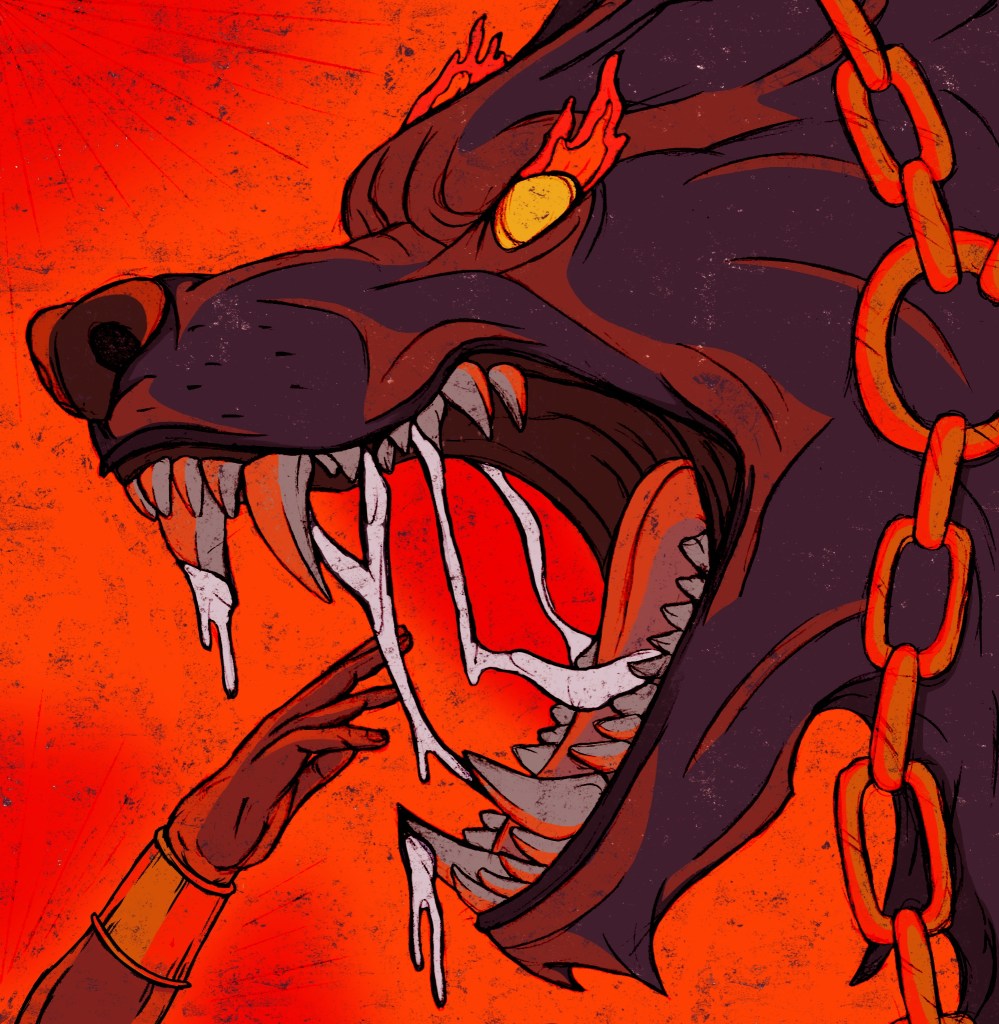
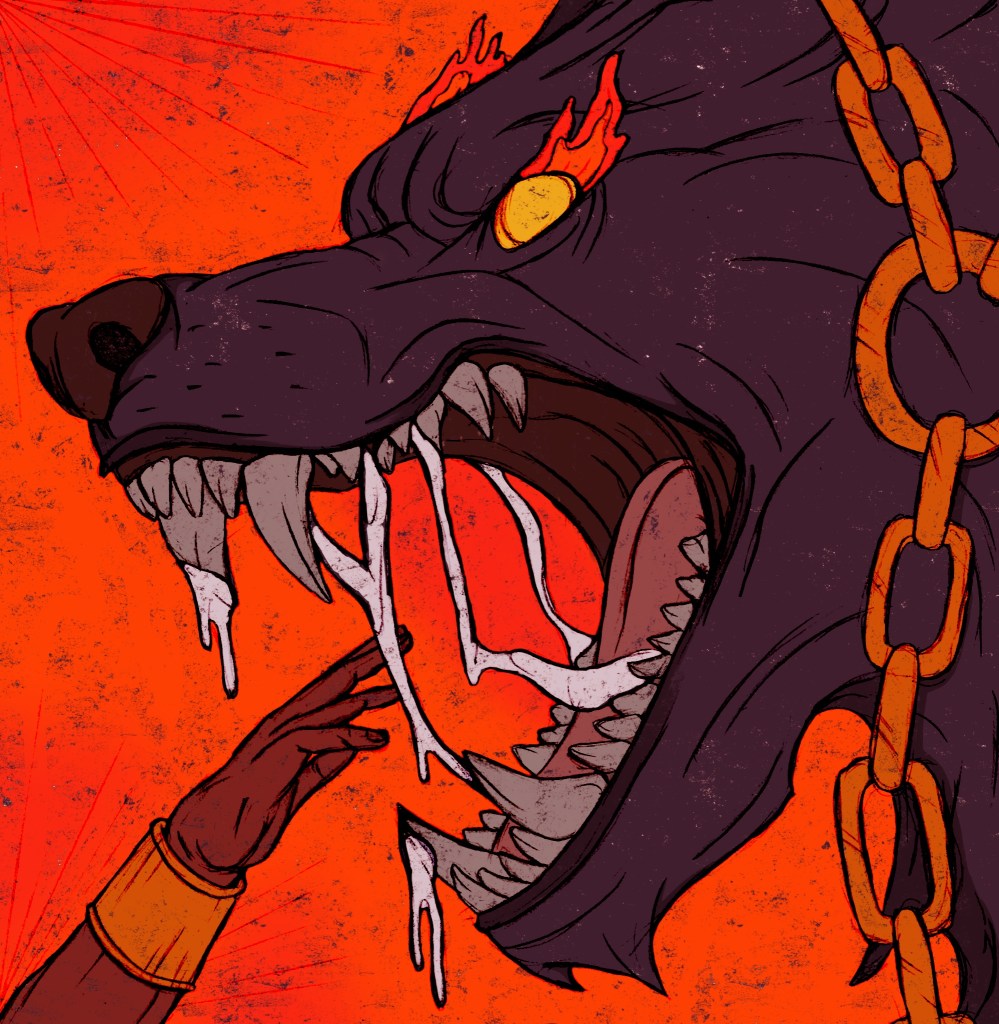
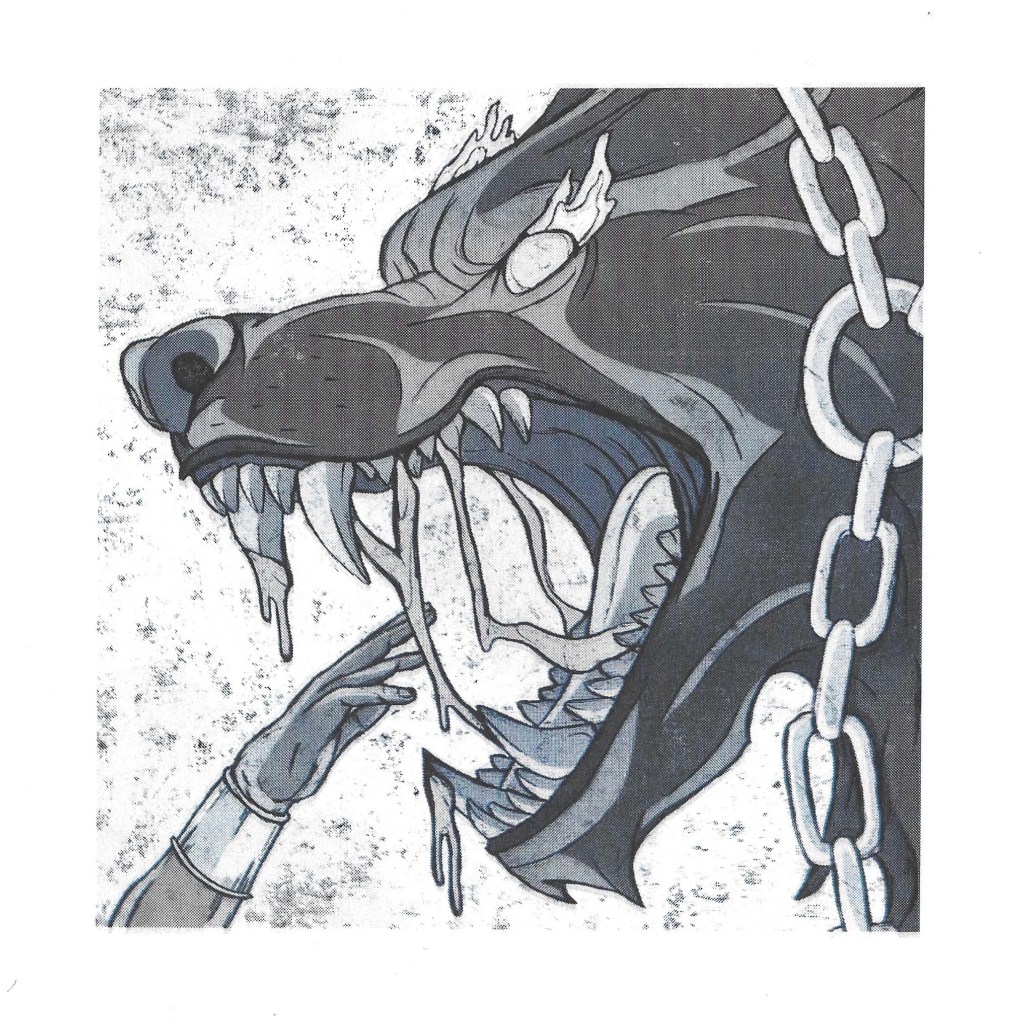
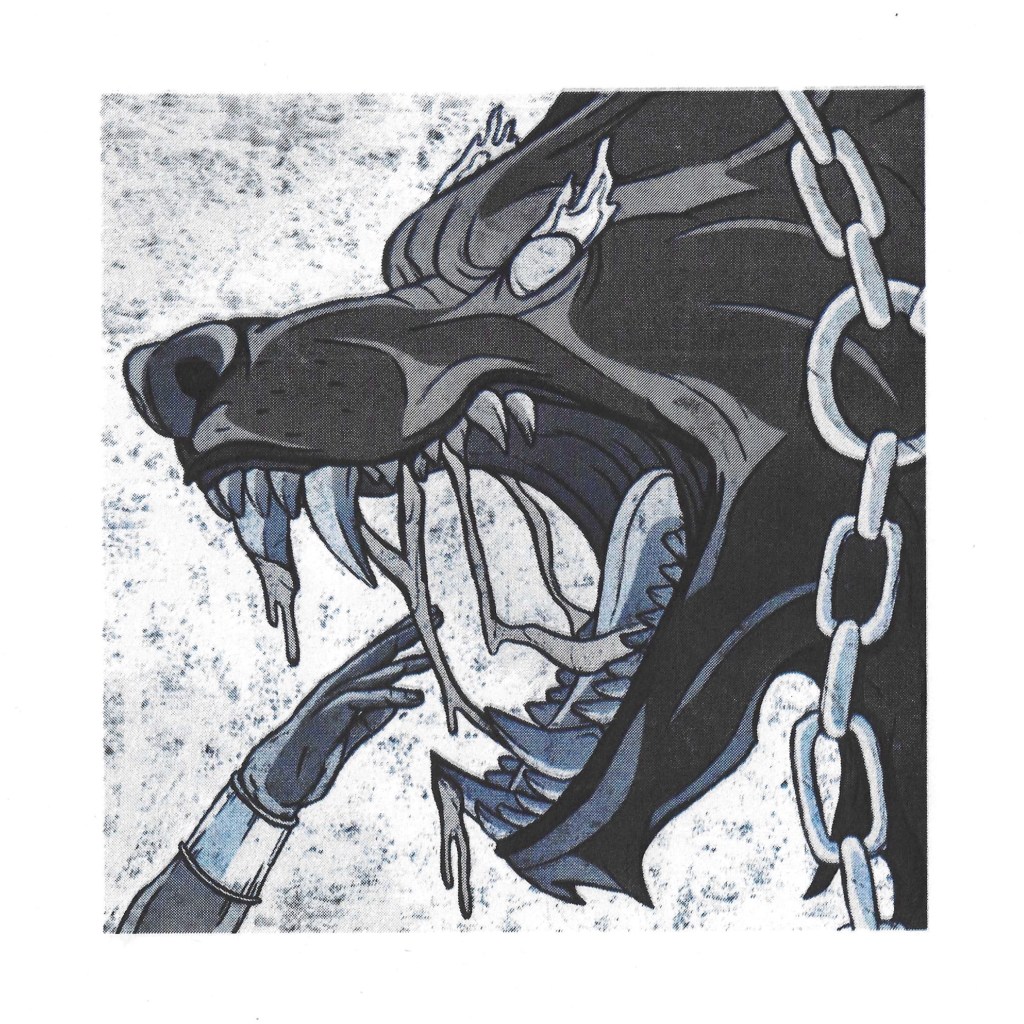
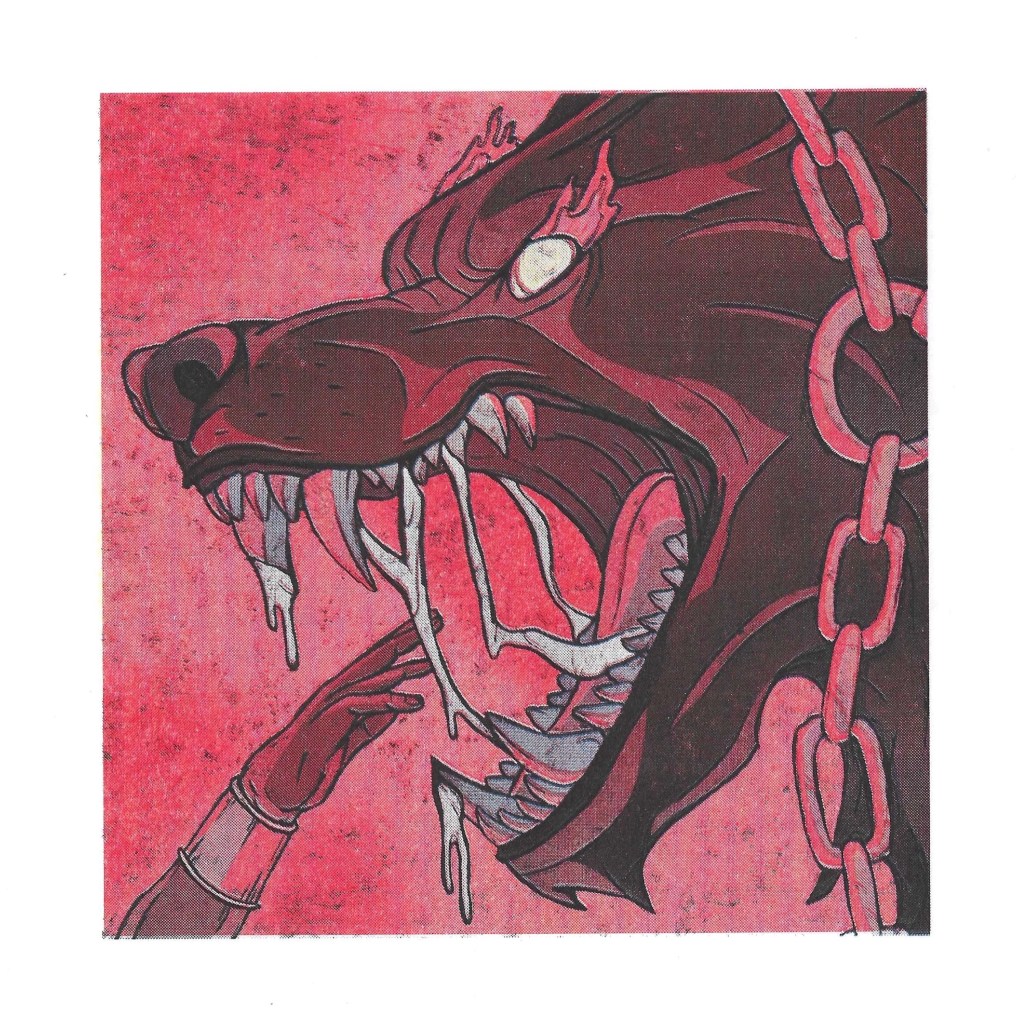
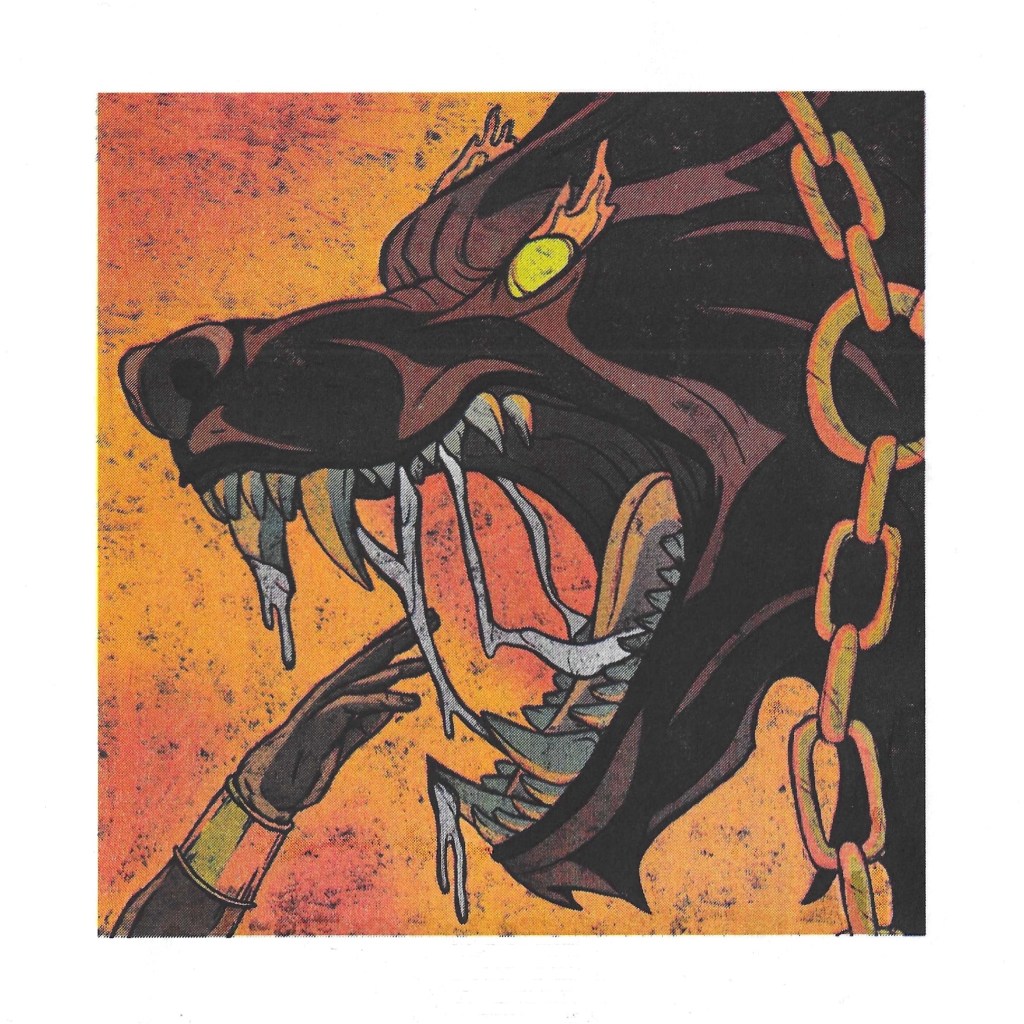
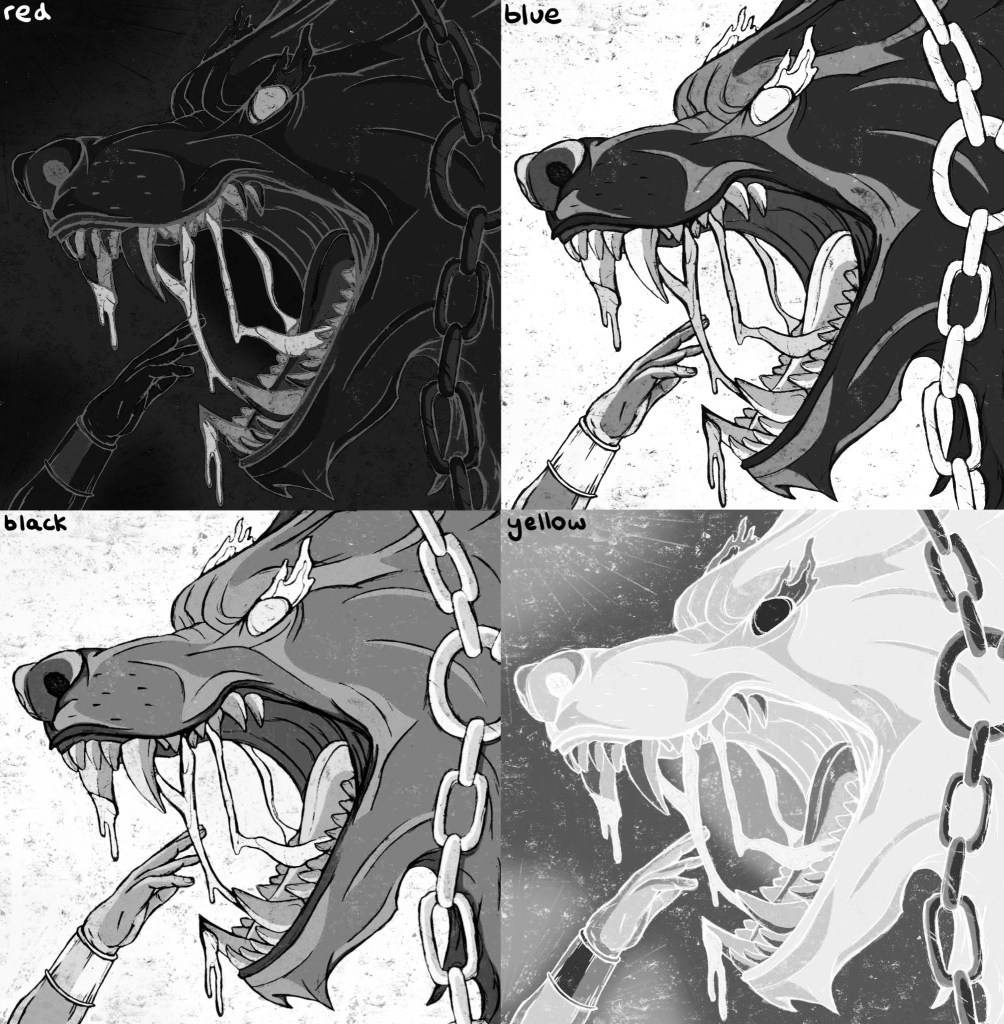
Binding of Fenrir: I chose to do this one as it’s in the middle on the timeline of myths that I illustrated and it’s one of my personal favourites. I really like the striking colour palette with the intense orange mixed with the cool blues. I wanted to experiment with these colours further by using different combinations of inks. Below is a selection of my prints with different colour variations:

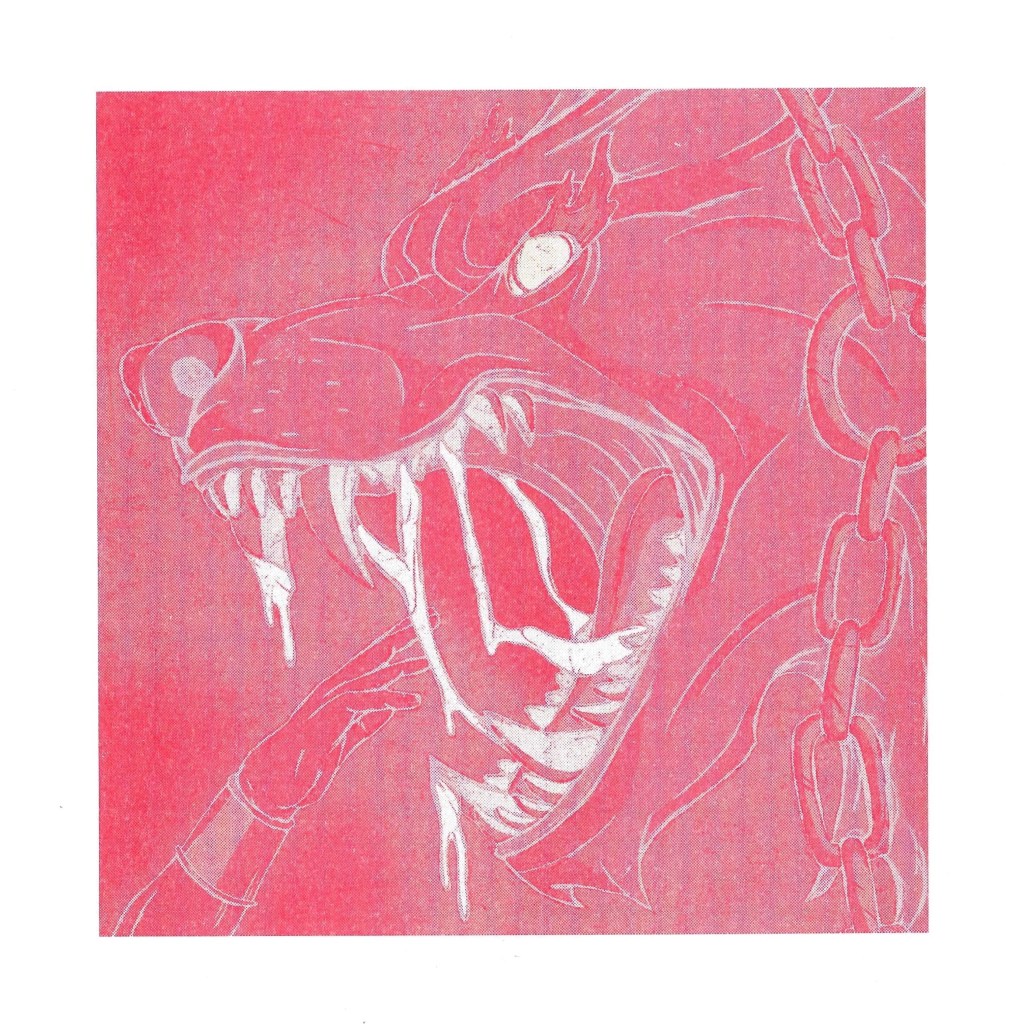
Red: with Riso printing you have to print one colour at a time and then layer the next colour over the top, making sure that the registration is correct. This is an example of a print with only 1 colour profile.
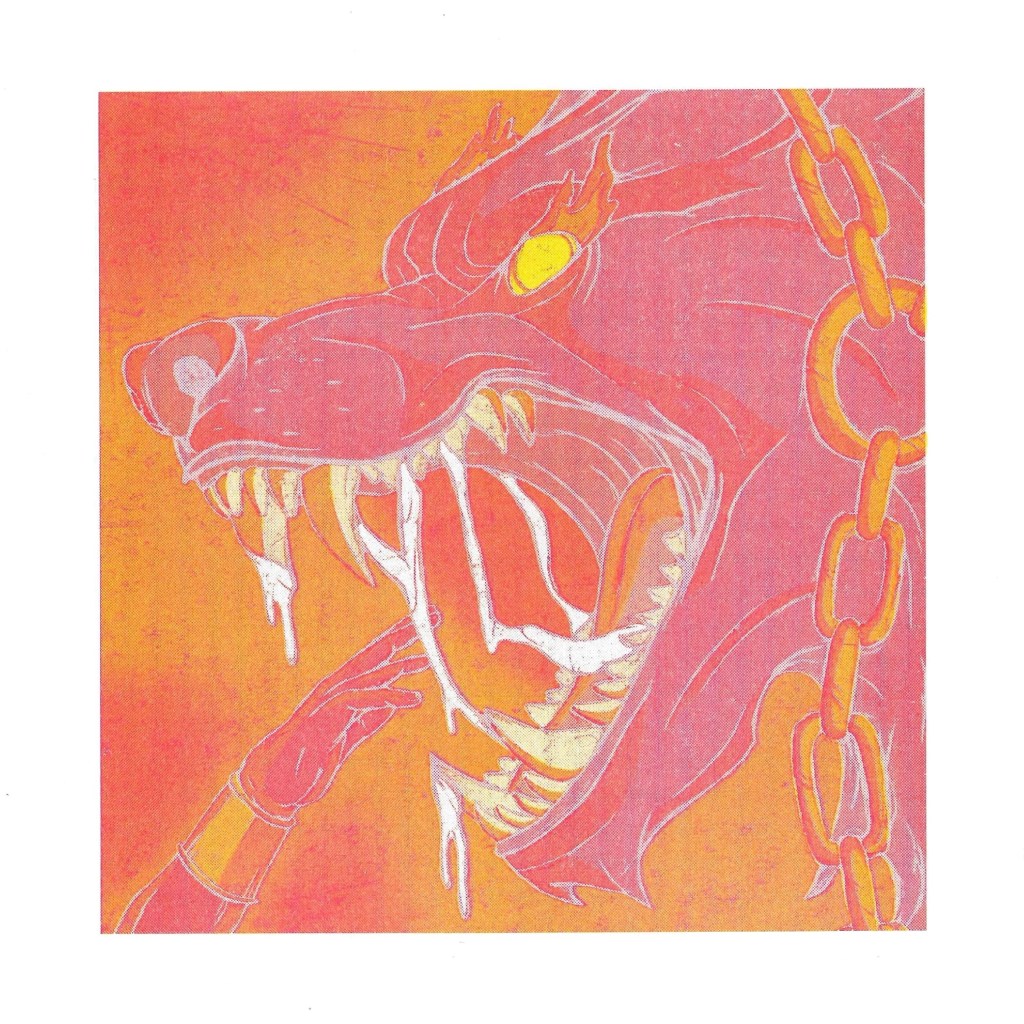
Red and yellow: here I put a yellow layer over on top of a red print. This is where it starts becoming interesting. This image has even more intensity than the original as it has the strength of the warm tones while removing the cold side of the palette. I think this is an interesting variation of the image but I think without the darker elements you don’t get the strong contrast that the original has.
Blue and black: with these prints I went for the complete opposite of the previous one, only using black and blue. The results of this were unexpected but I really like these variants. The cold tones give the image an icy feeling rather than intense heat. I think it still maintains the drama but takes the palette in a direction I hadn’t considered. Below are 3 versions of this colour combination. For the second one I added 2 layers of black and for the third one 3 layers. This was to experiment with the boldness of the colours. I really like the gritty texture that’s in the background.
Red, blue and black: this was a colour combination I tested using the colour profiles in Photoshop. By removing the yellow it creates a darker tone, while still maintaining the feeling of extreme heat. The second one has a double layer of black and blue. I prefer this one as it makes Fenrir and the hand stand out more from the background as there’s a greater contrast.
Red, yellow, blue and black: these prints have all 4 colours so are the full colour prints of my illustration. I’m really happy with these prints, they show my image with the palette I original made. I especially like the second one which has double layers of blue and black. I think this best shows the contrast that I had in my original design.

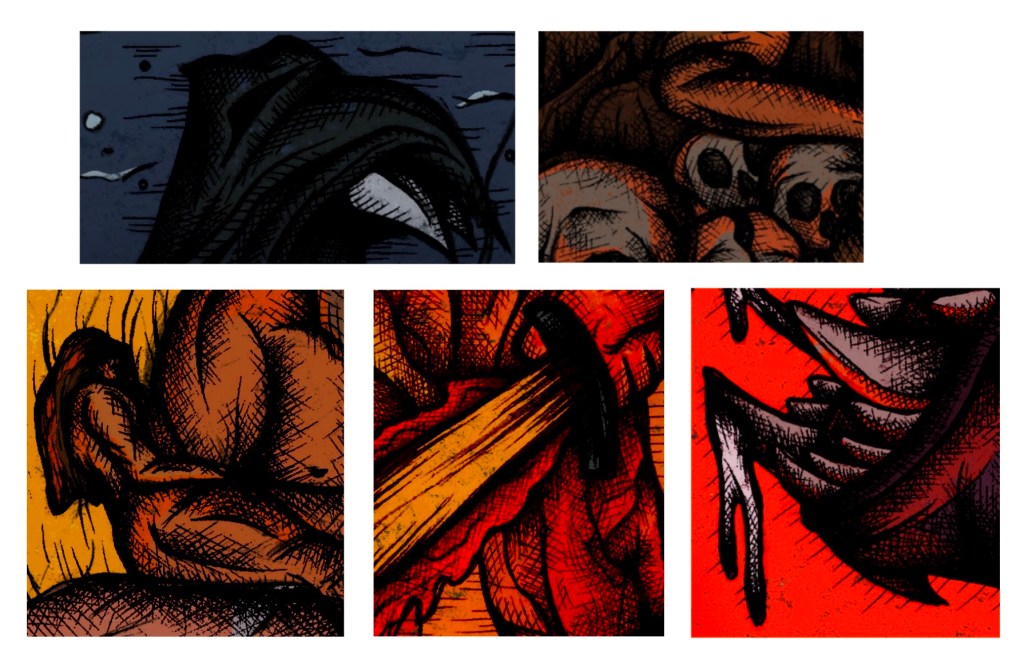
Hatching over Riso print: I wanted to bring back in some hatching over one of the prints. I chose to add the pen work over a red and yellow print. This lighter palette allowed the black pen to really stand out. As I found through experiments earlier in the module, my preferred style of shading with a pen is using street line hatching so this is predominantly what is in this image. I’m happy with this image as I think it successfully combines the 2 mediums.

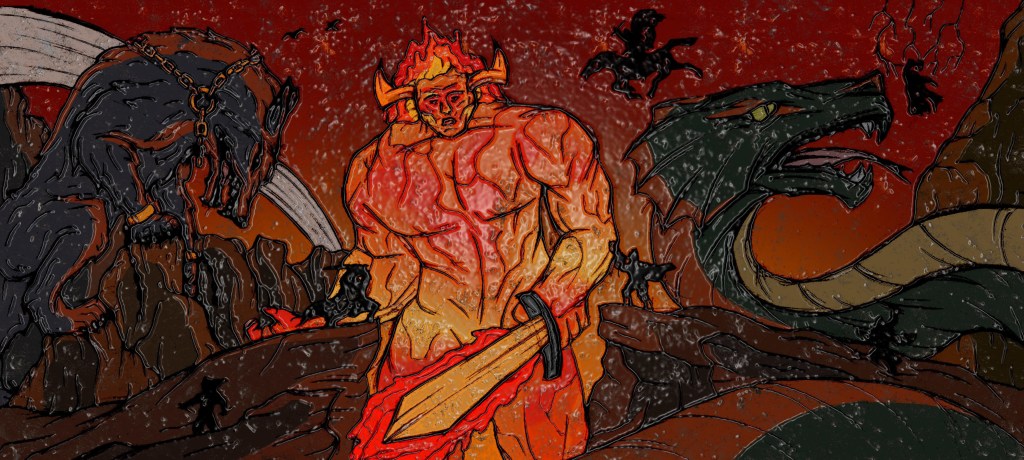
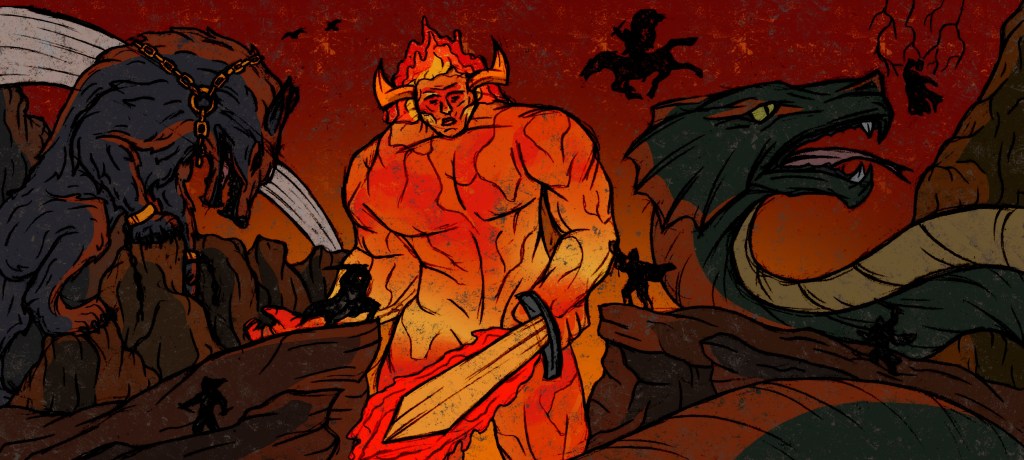
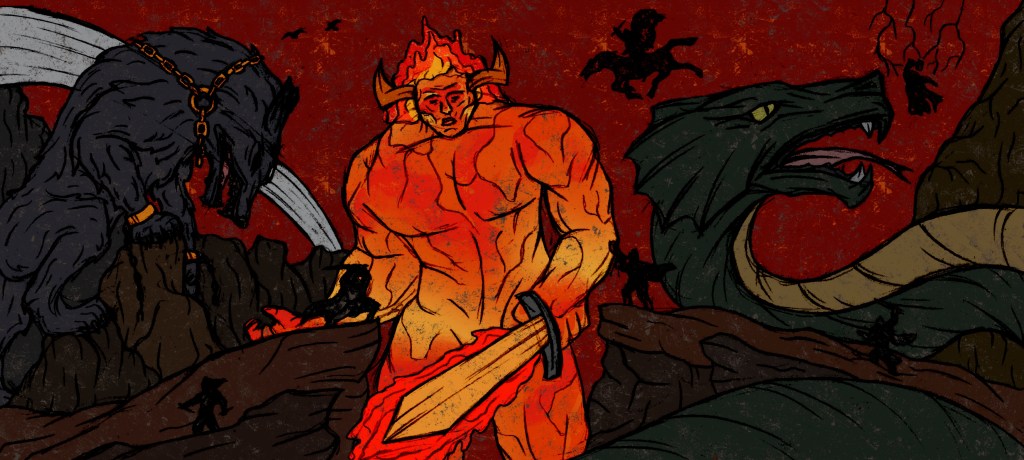
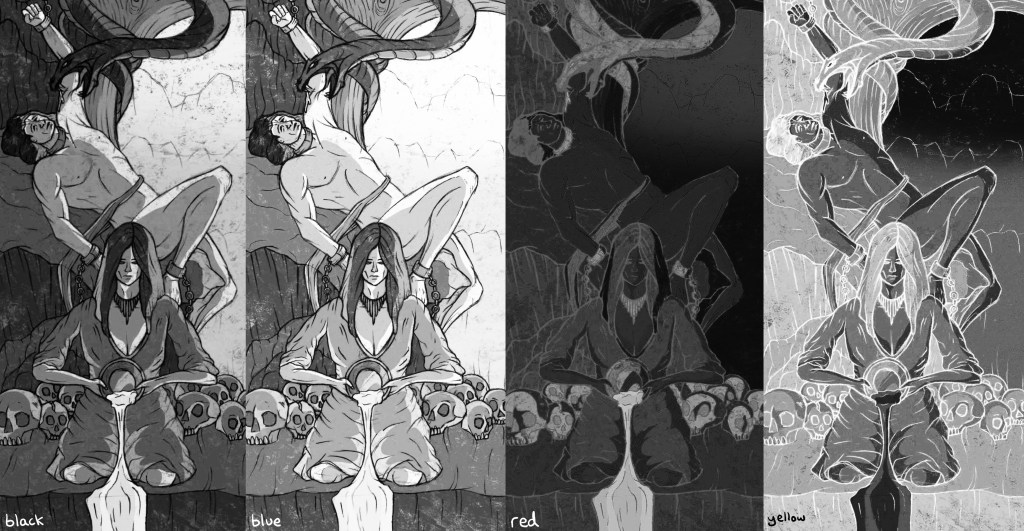
Ragnarok: this is the other image I chose to print with Riso. It’s the climax of Norse mythology and one of my favourite designs. I really like having the 3 giants together in one image. Also Ragnarok is the topic of my essay so this was another opportunity to explore this myth. Below are a selections of my prints with different colour variations:

Red: This is an example of a print with only 1 colour profile, red. I think the single colour prints are interesting visual experiments but I don’t really like them as final images. They’re lacking a lot of the depth and contrast that the original images have.
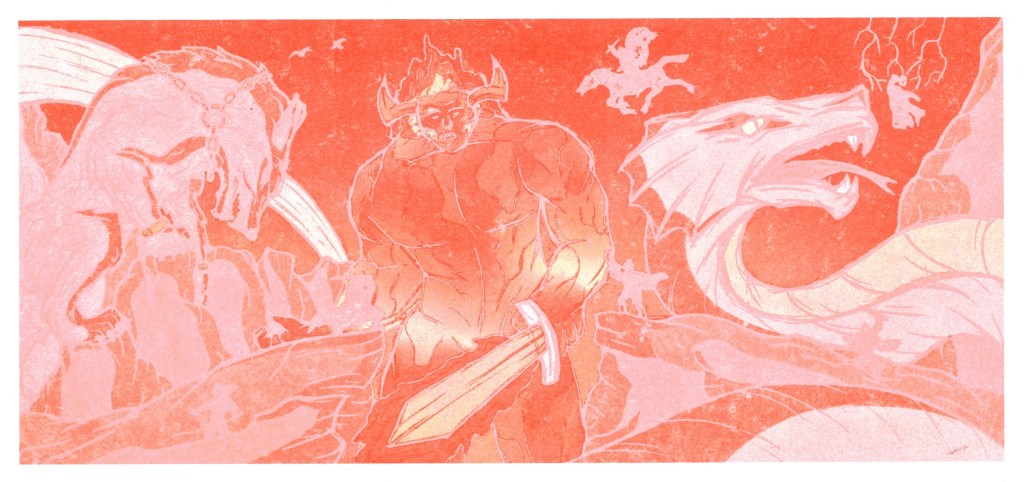
Red and yellow: here I put a yellow layer over the red print. I like the way that Surtr looks but I still think Fenrir and Jörmungandr feel a bit lifeless as they’re missing the darker tones that they originally have. One interesting element of the image are the gods. In the original they’re black silhouettes but in this version they’re a lot lighter. They seem abit like ghosts which is interesting foreshadowing for the death of the gods.

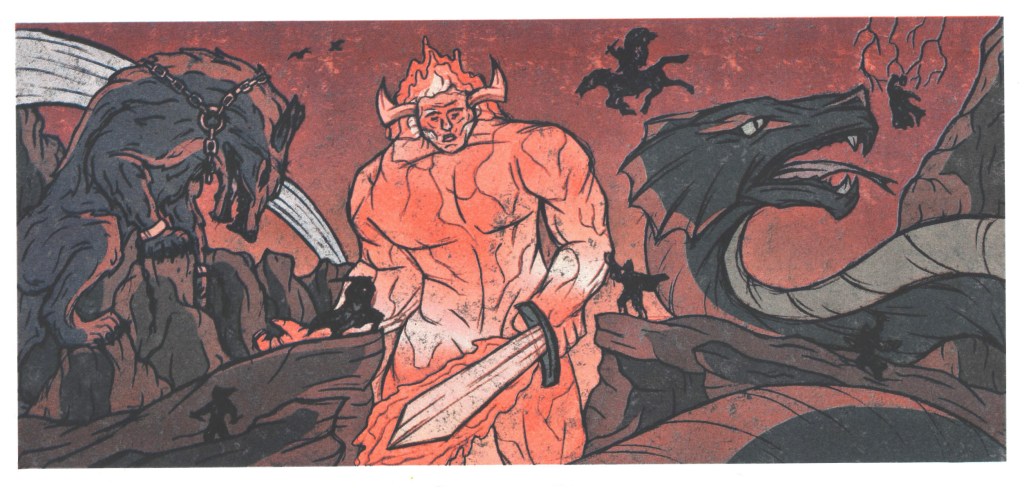
Blue and black: I really liked the blue and black prints for the Fenrir image so wanted to try that combination for this image too. Once again I’m very happy with this combination. There’s a nice amount of detail and contrast and contrast betweenthe light and shadows. It’s a huge difference from the original design but I like how cold and sombre this image feels with the darker, colder palette.

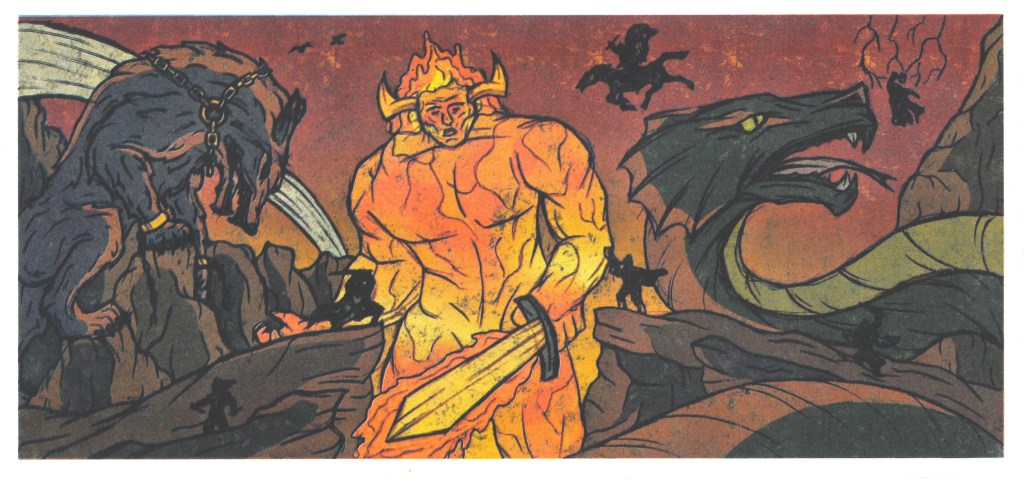
Red, blue and black: I knew I wanted to try out this colour combination after testing it on Photoshop. It’s not drastically different from the full colour version but just has more of an emphasis on red. It has a nice dramatic tone and the colours translate the idea that this is just before the end of the world.
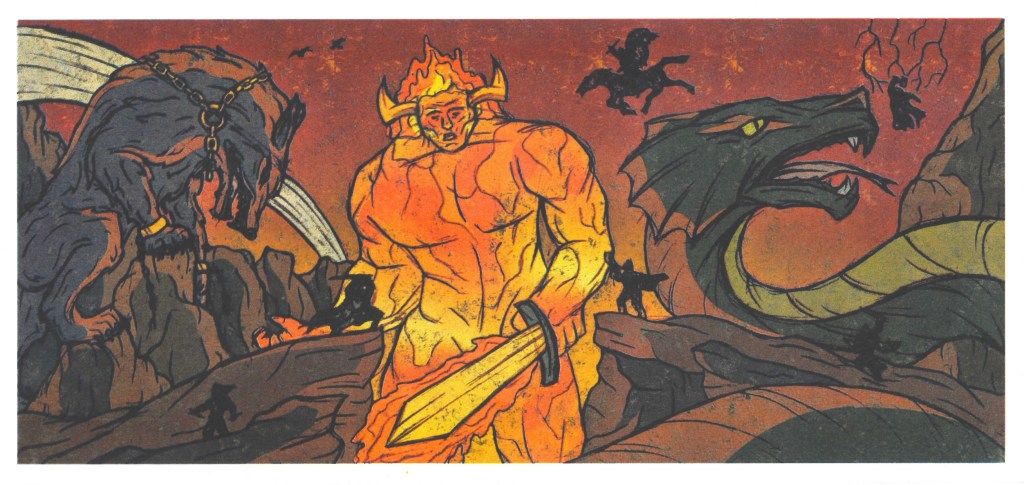
Red, yellow, blue and black: these prints have all 4 colours so are the full colour prints of my illustration. I’m really happy with these prints, they show my image with the original palette. I especially like the second one which has double layers of red and yellow, highlighting the warmth of Surtr and the intensity of the apocalyptic event.
I had lots of fun doing the Riso printing and learnt so much about the technique from my session in the studio. I’m really pleased with the outcomes of my prints as I was able to create lots of different colour variations of 2 of my illustrations. I got some prints that showed my illustrations as I had intended and through experimenting with different colour combination I achieved some prints with completely different tones. This was a really valuable experience and helped me develop my illustrations further and see new possibilities for them. If I had more time I would have liked to print all 5 illustrations to have the whole series. I intend to still do this in my own time.
Categories
Contextualised Practice Contextualised Practice: Project Level 5

Contextualised Practice: Experimenting with styles

I have my finalised colour illustrations and I wanted to do some experiments to see how they would look with different filters and variations. This helped me get an idea of potentially what formats my work could take other than just printed images. It also helped me see how to expand my work to different audiences.

Hatching over colour: I took the hatching sections that I made and overlayed them onto my coloured illustrations to see how the 2 elements work together. I like the style but I prefer the style that the images already had as I feel this style of dense hatching and shading makes the illustrations too dark and block some of the colour. If I was to do a whole image with this combination, I would make the hatching less dense to allow the colour palette shine.

Photoshop filters/editing: all of the other experiments were done on Adobe Photoshop using the image filters. For each I did the whole set of illustrations as I think it’s key that they’re kept as a set. While they work as stand alone images I think they are made better when placed together and get a better sense of the whole story.

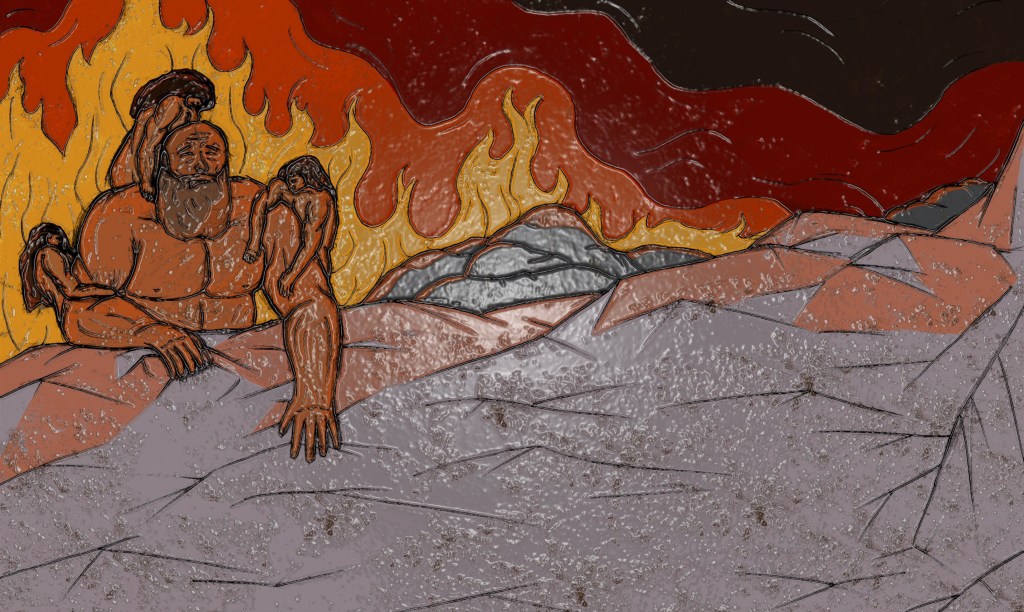
Plastic wrap filter: this filter is my favourite out of all the ones I tried. It makes the images look like glossy tiles. This is an outcome I had never considered but I now think these illustrations could make a really nice set of decorative tiles.

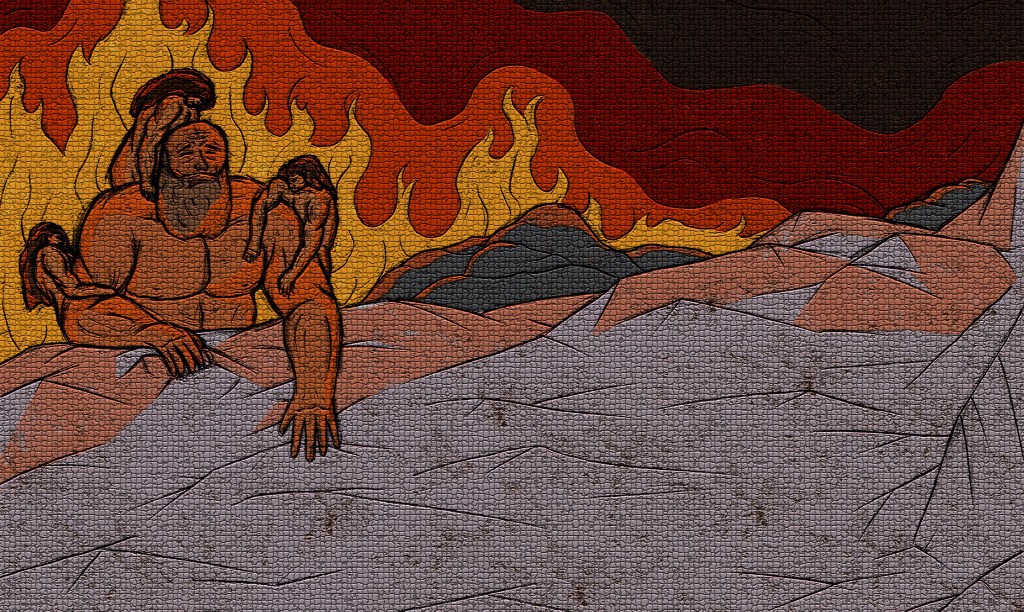
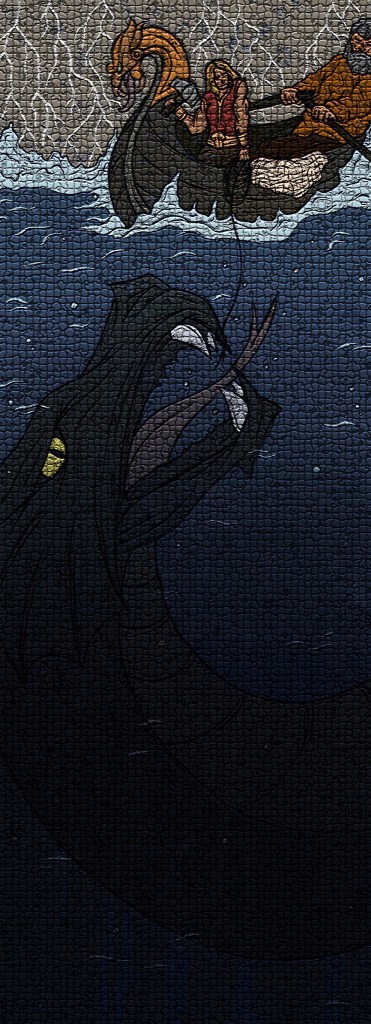
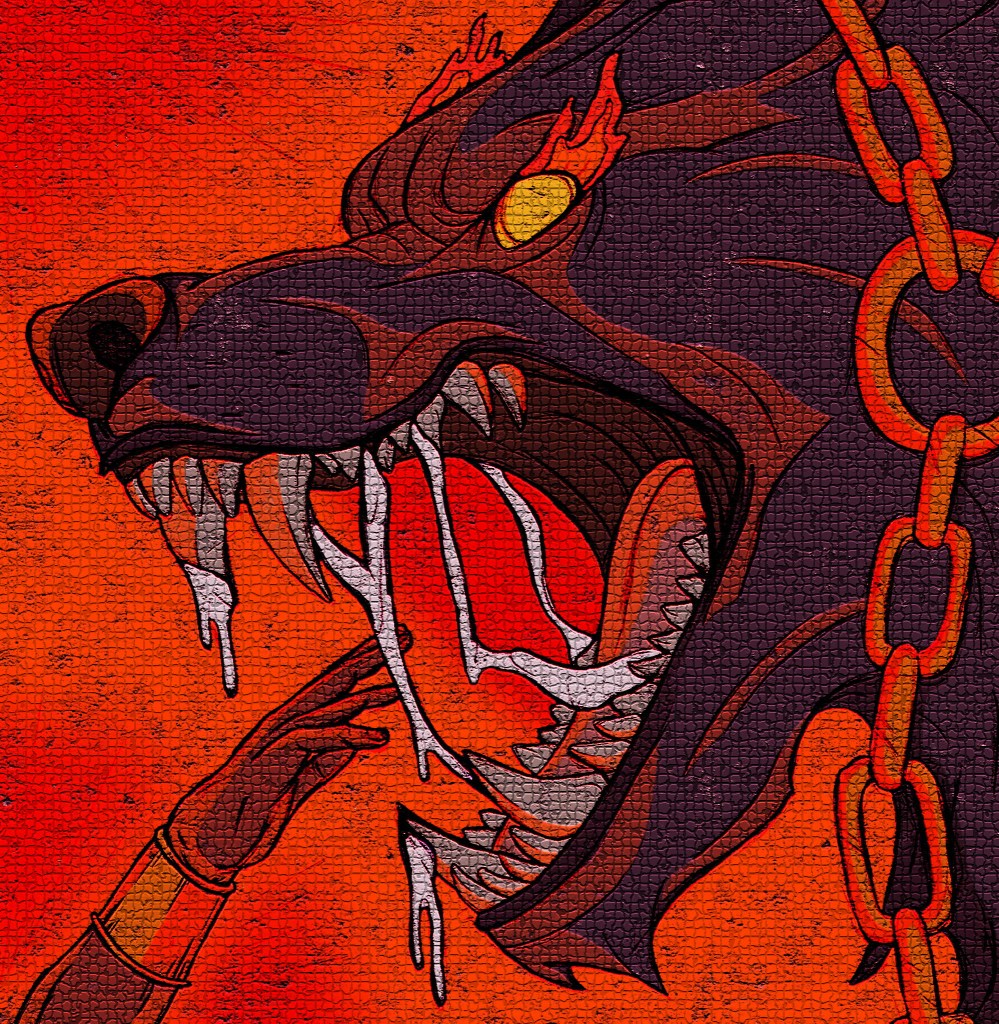
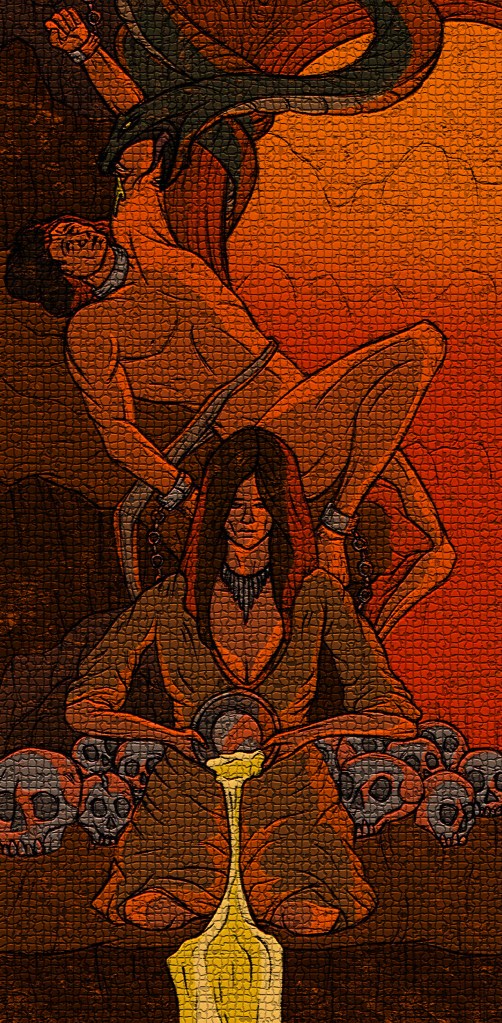
Mosaic filter: continuing with the theme of tiles, I applied a mosaic filter to my series of illustrations. I think having these as mosaic pieces would be interesting as it’s an old technique which contrasts my modern style of illustrations. I can imagine these being big mural style mosaics which would an interesting way to experience them.

Fresco filter: to achieve these I used a combination of the Fesco filter on Photoshop and overlaying some of the textures I created in the creative workshop. This really lightened up the images and added more of a random texture. I like the aesthetic and think they could make interesting posters which could be scaled up or down. I wouldn’t replace the originals with them but I think they’re a fun variant.

Black and white: these are greyscale versions of the colour images. It’s interesting to see how they look without colour as colour was such a key part of my development of the illustrations. I think seeing them like this shows the strength of the designs and compositions and the still tell the stories and are visually strong. However, the colour really elevates them so I wouldn’t use greyscale version of the images for any sort of outcome.

Creating these different experiments was a fun process and gave me some new ideas on what formats and styles my illustrations could take such as a tile or mosaic.

Categories
Contextualised Practice Contextualised Practice: Project Level 5

Contextualised Practice: Preparing for Riso Printing

Now that I have my finalised colour illustrations I need to prepare the files for in the correct way for Riso printing. One important thing I did throughout the process of colouring the my images was to put each bit of colour on a different layer. This made adjusting the colour easier and will make creating the colour profiles easier.

Color/shift: downloading colour profiles

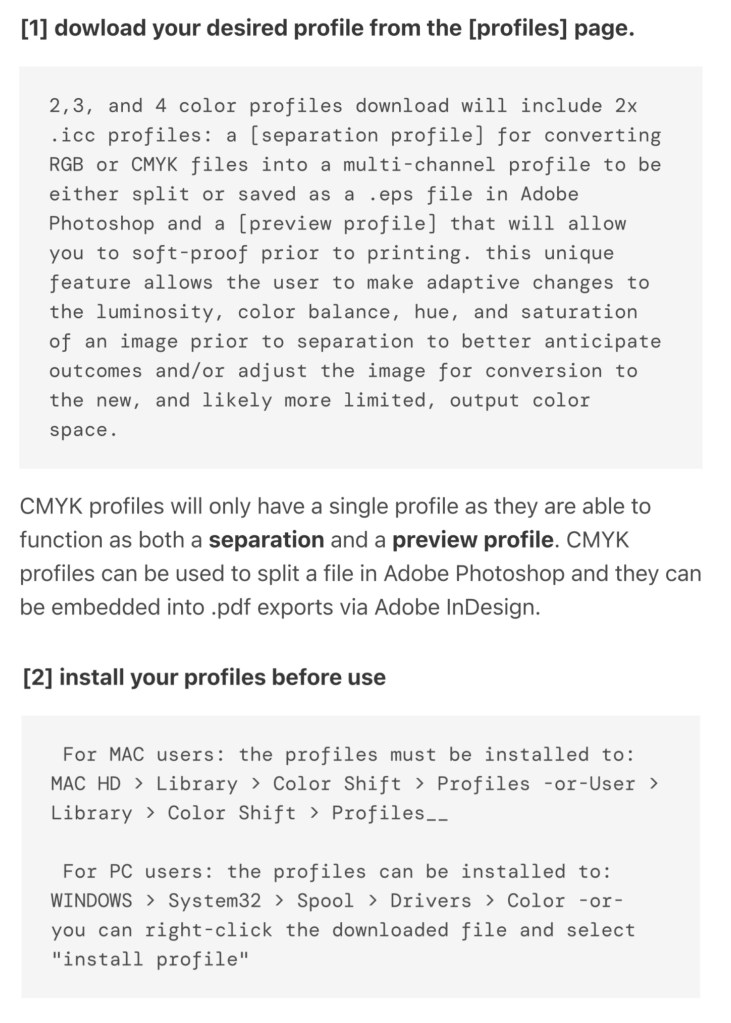
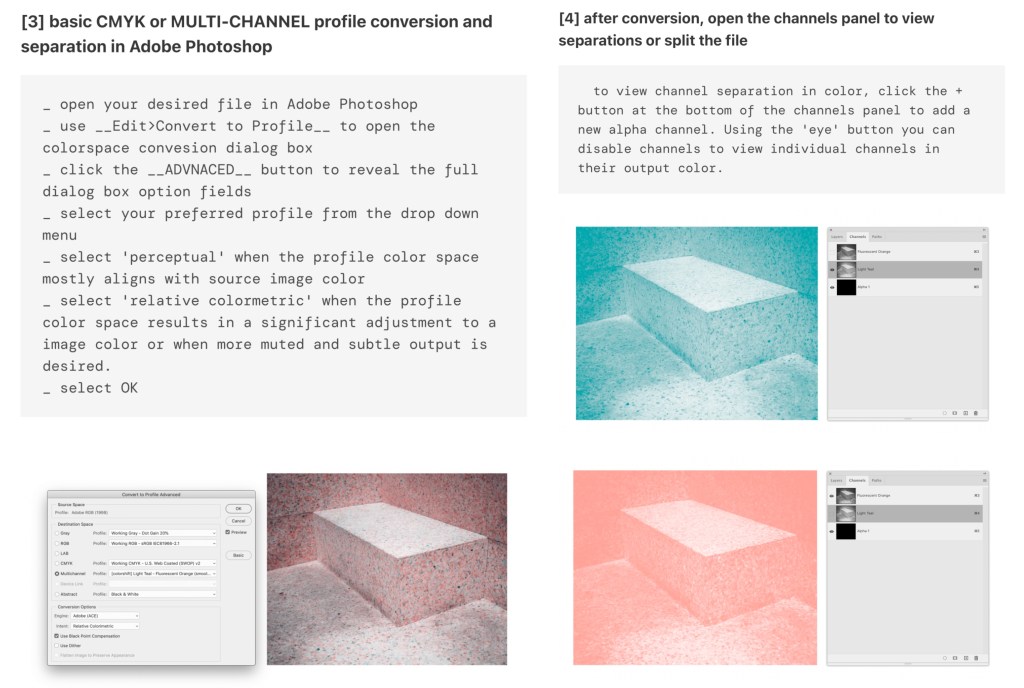
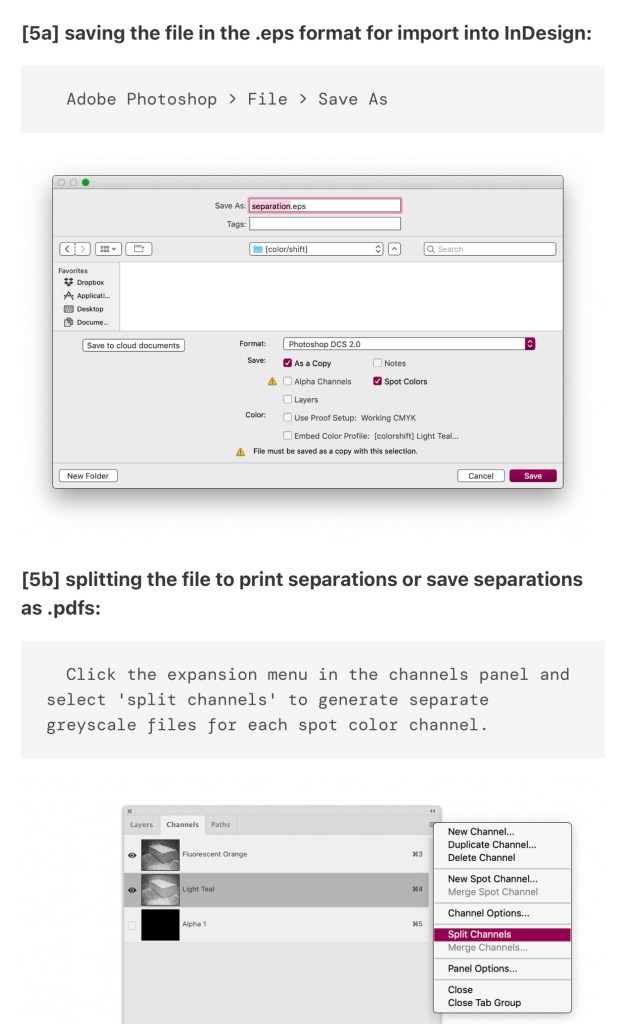
During the induction I learnt about a couple of different websites that can be use to create colour profiles for Riso printing. The one I used was Color/shift. Using this website you can download specific colour profiles and then add them to an image and it will automatically sepertea the colours. Below is the link to their website and a list of instructions on how to download and use different colour profiles:

https://colorshift.theretherenow.com/how-to-use

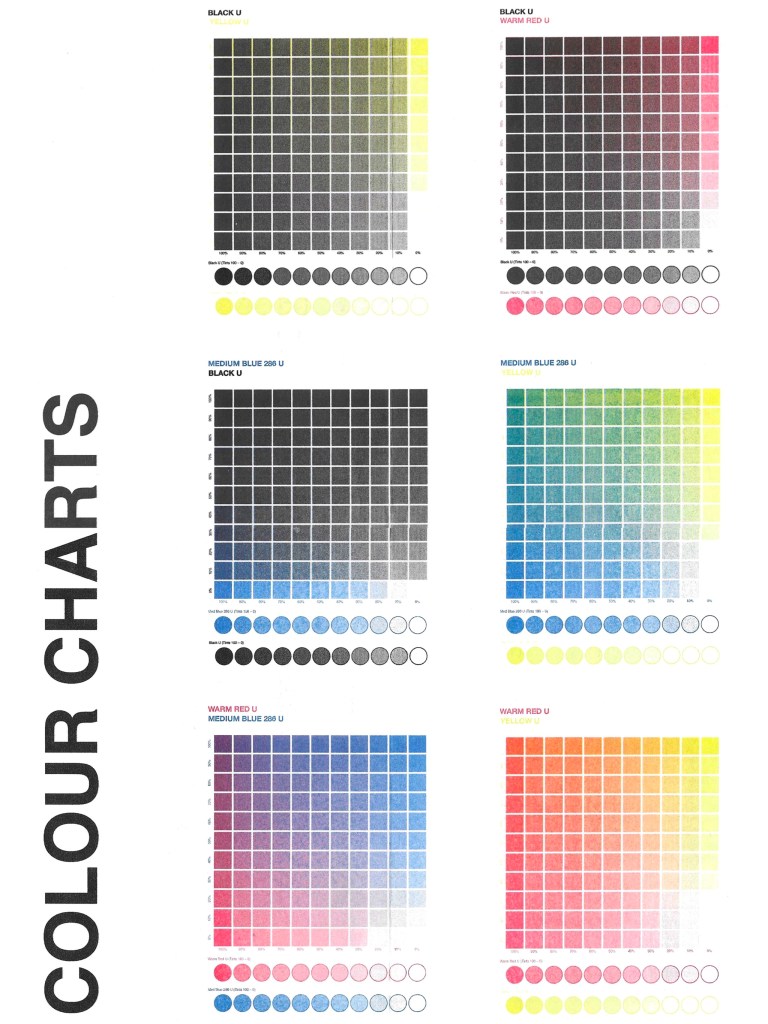
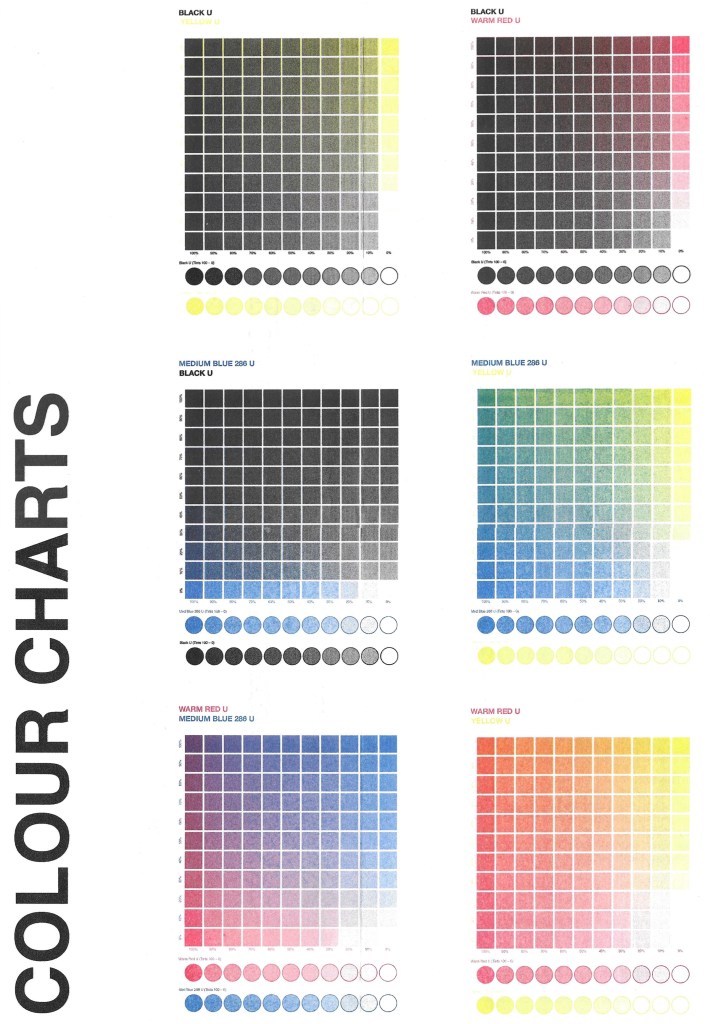
Colours available at University for Riso Printing: when picking what colour profiles to use it was important to keep this colour chart in mind as I will only be able to achieve these colours:

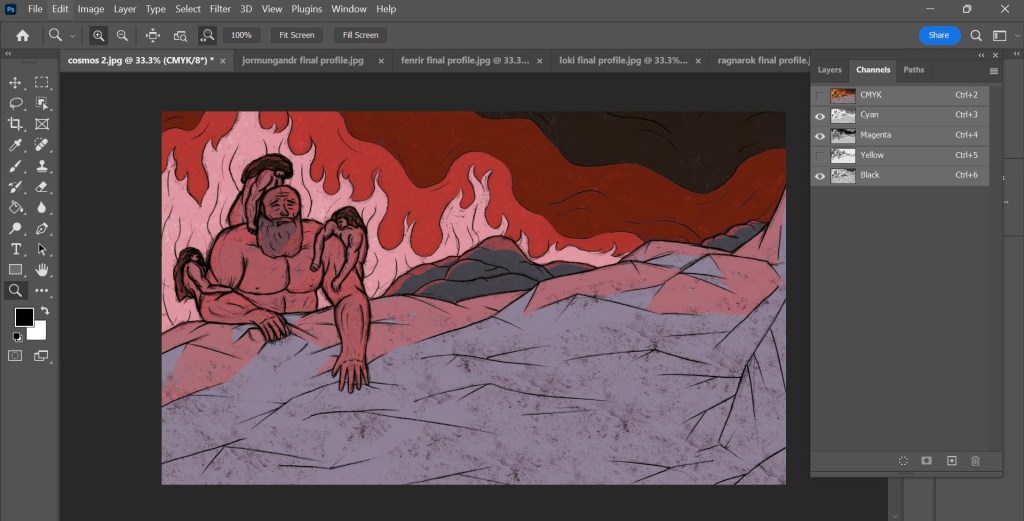
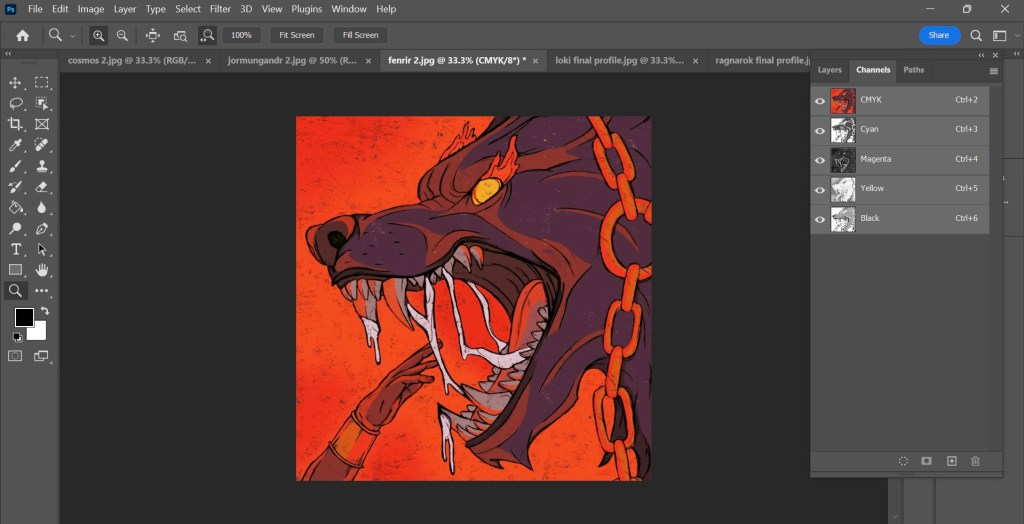
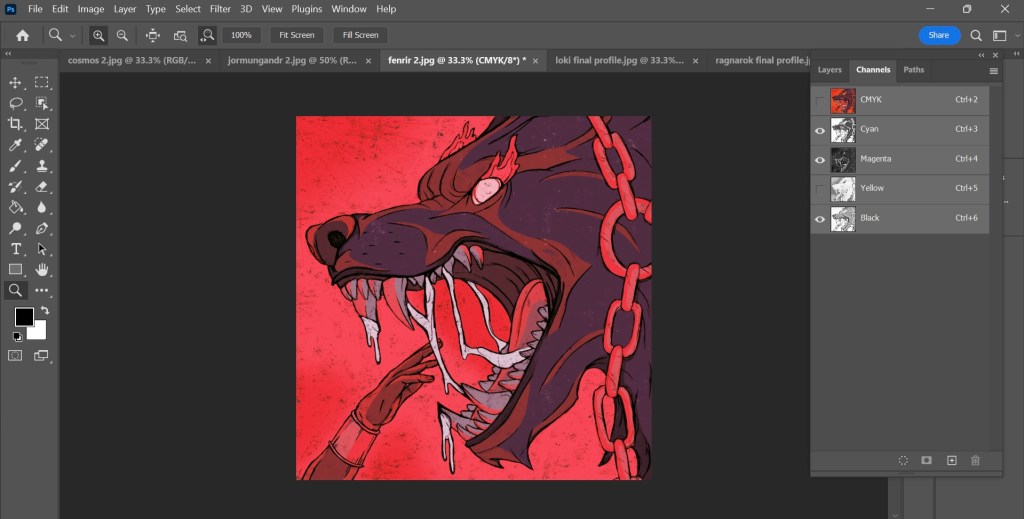
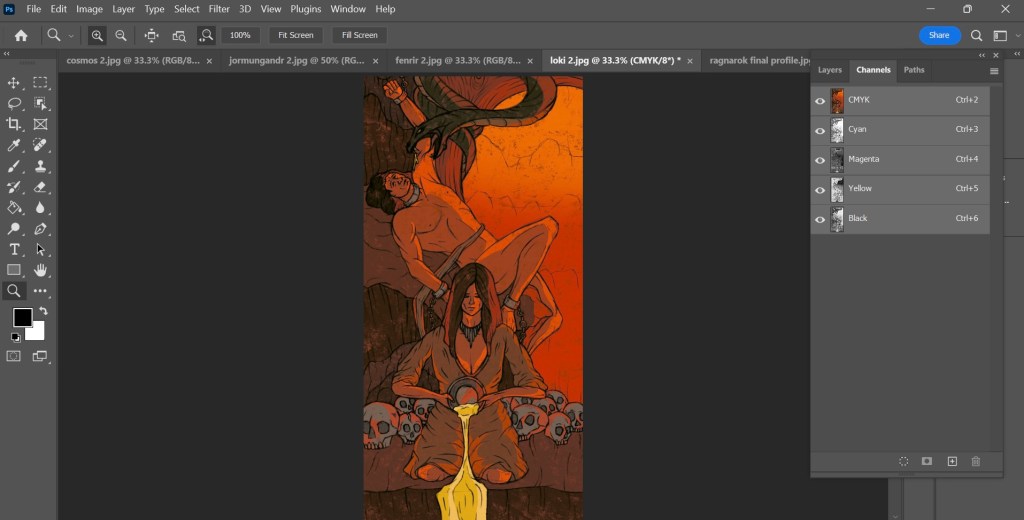
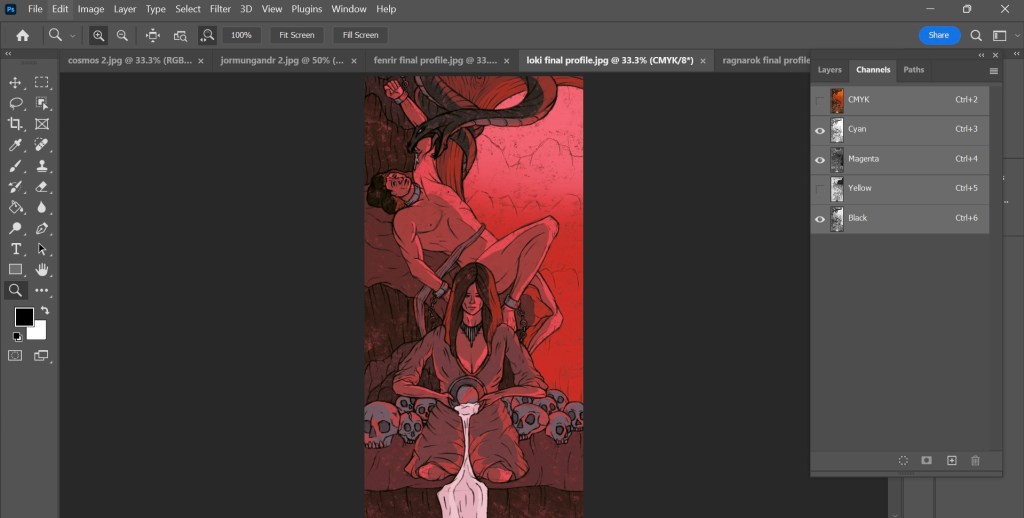
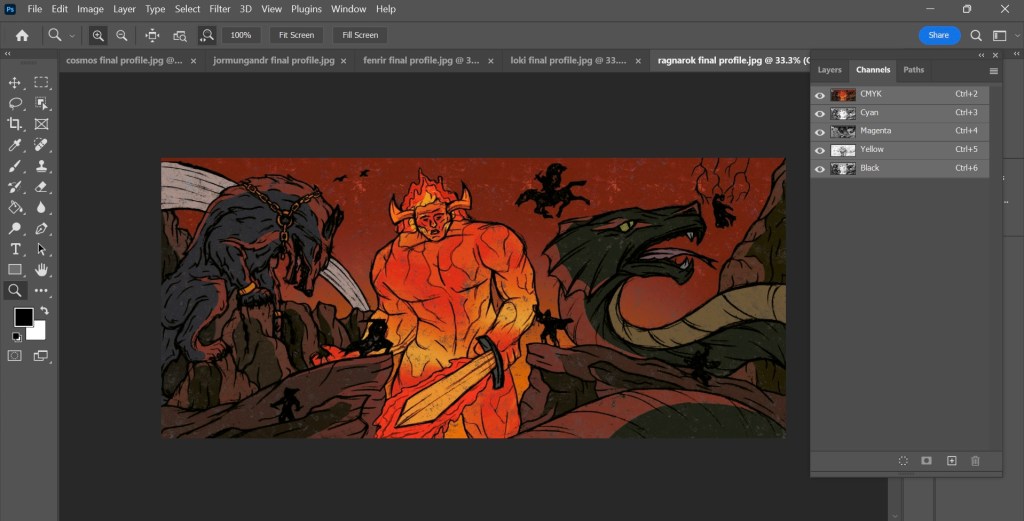
Photoshop Colour Profiles: I downloaded the CMYK colour profile as it is very close to the blue, red, black and yellow that I can use for Riso printing. With this I was able to get an idea of how the prints will look and what potential colour combination I could use. Below are screenshots on the colour profile being applied to my illustrations. The top one for each is a combination of all the colours and the second has one colour removed.

Creation of the Cosmos:

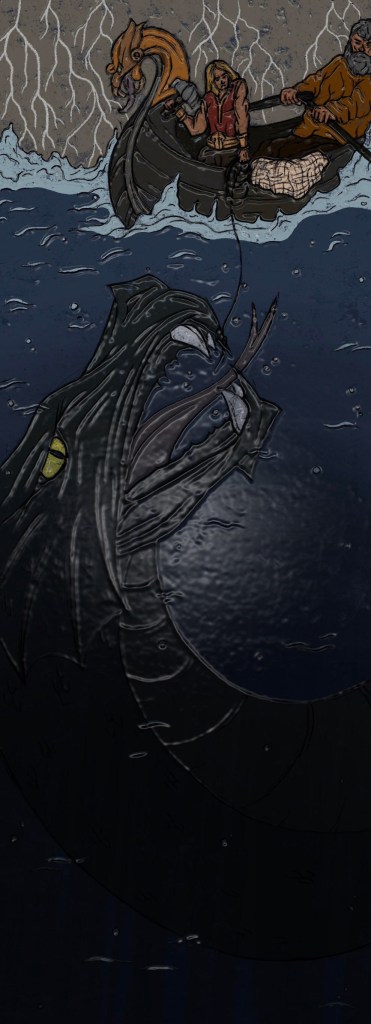
Thor fishing Jormungandr:

Binding of Fenrir:

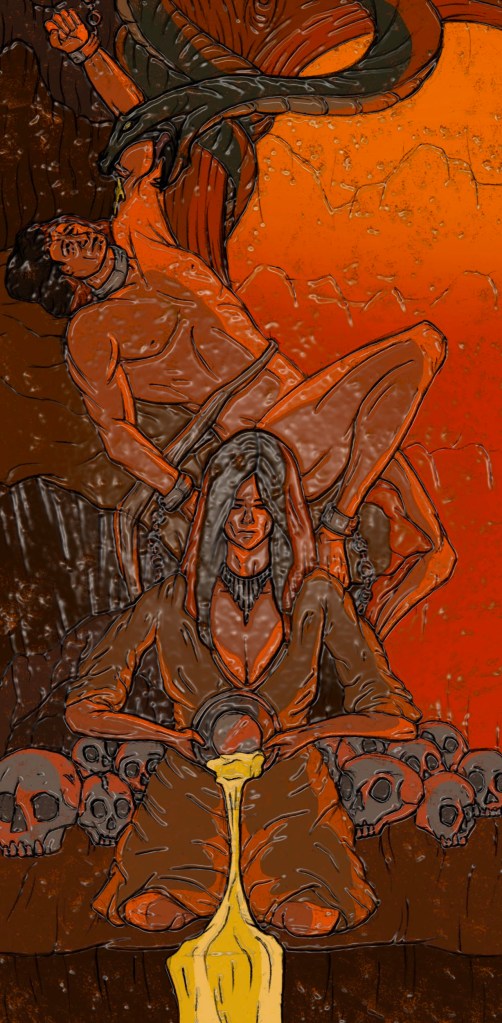
Loki bound:

Ragnarok:

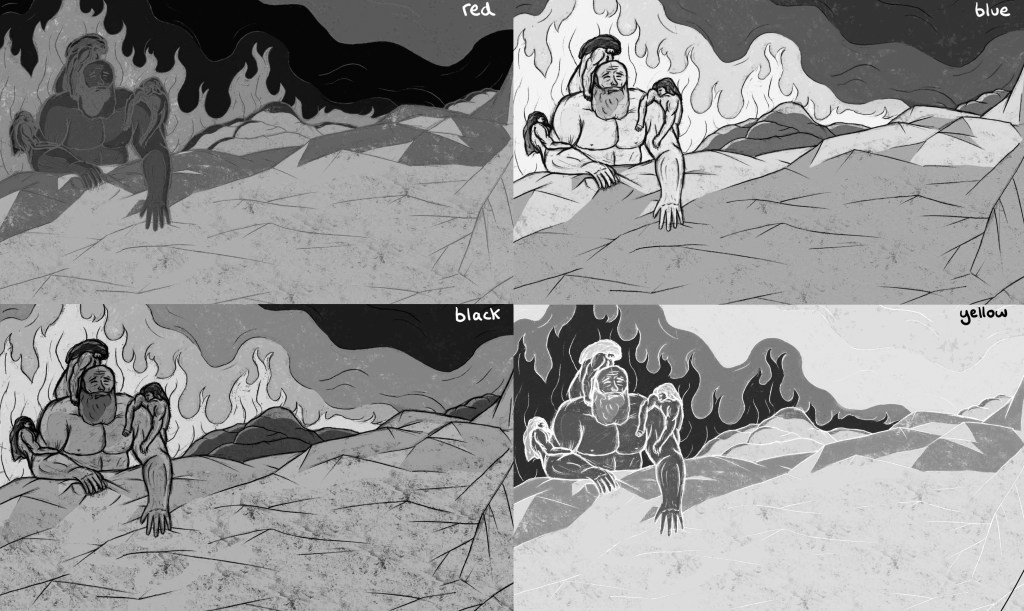
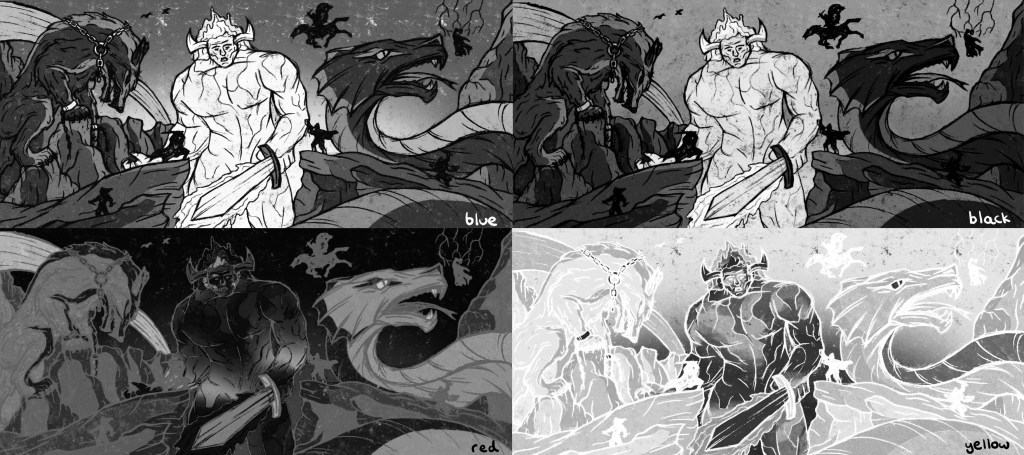
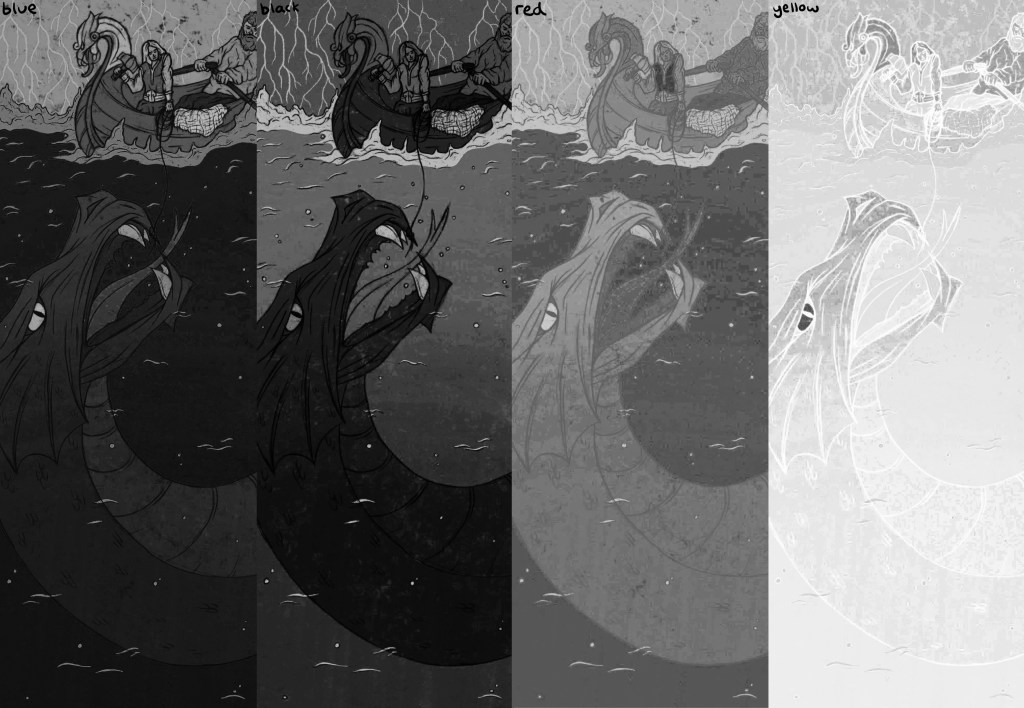
Colour Seperations: after applying the colour profile to my images and experimenting with different combination I separated each layer. When you separate them they automatically become greyscale as this is the format they need to be in for Riso printing. I then saved each separate colour profile as a PDF. Below are the 4 colour separations for each illustration that I can use for printing:

Now that I’ve added the colour profile as saved each colour separation as a PDF I’m ready to begin printing.

Categories
Contextualised Practice Contextualised Practice: Project Level 5

Contextualised Practice: Finalising the colour

I had the base colours for each illustration and after I reflected on them it was time to make the necessary changes and improvements in order to finalise the colour.

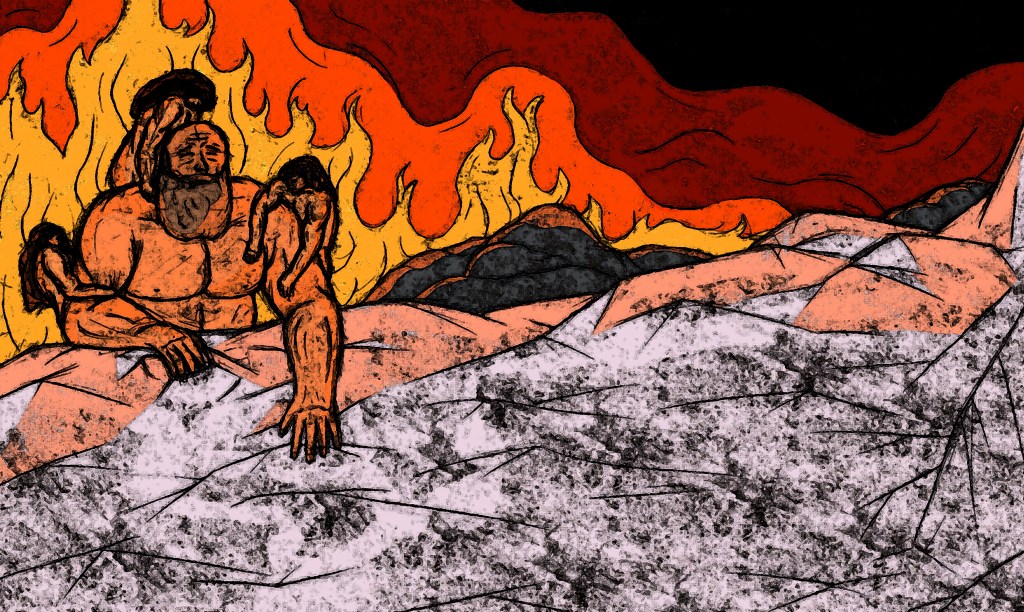
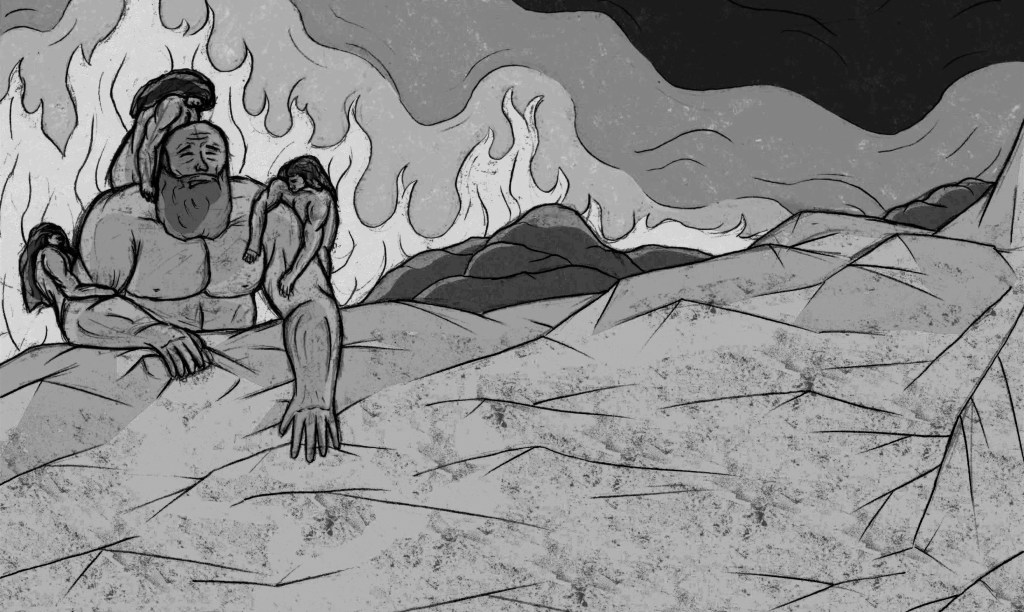
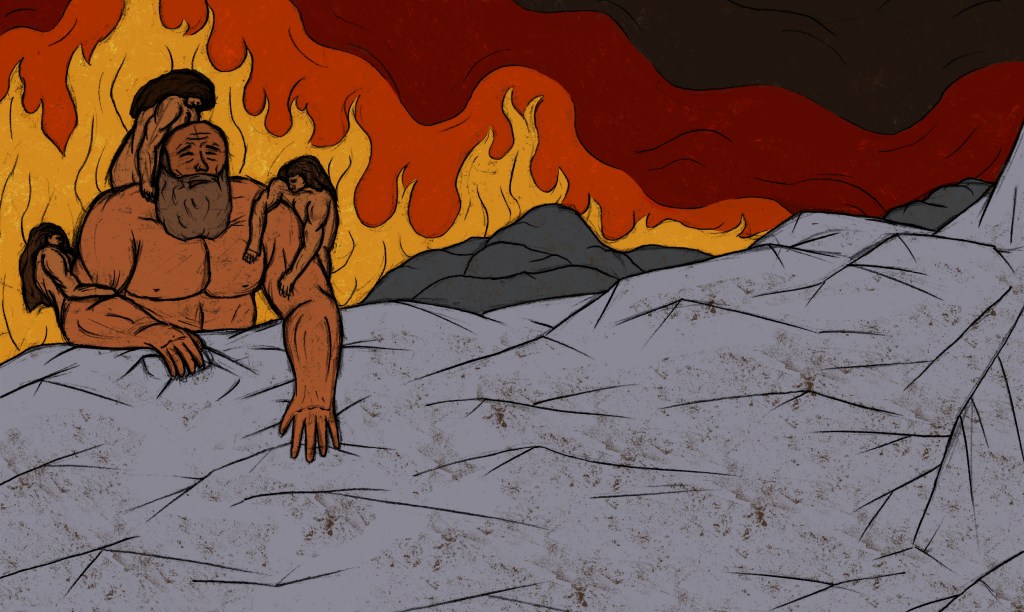
Creation of the cosmos: the main change was adding reflections and glow from the fire onto the characters, rocks and ice. This change really ties the 3 parts of the composition together.

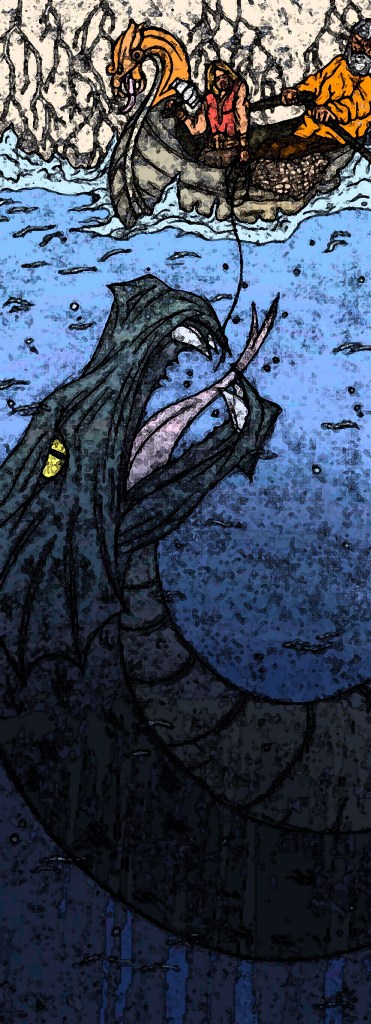
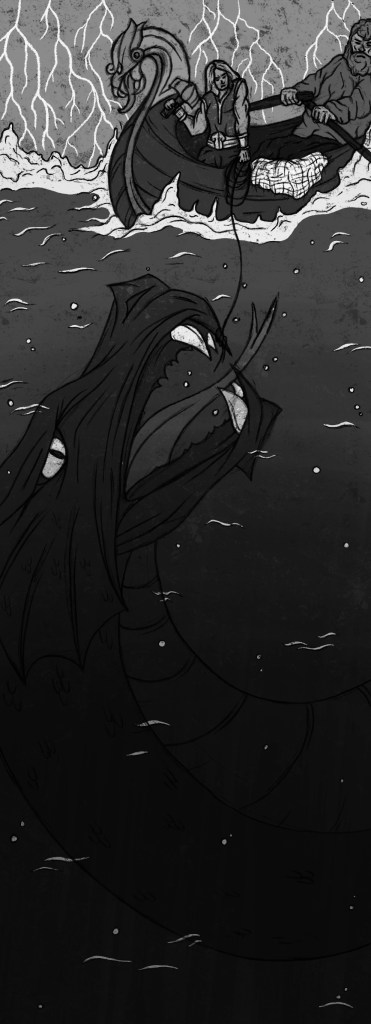
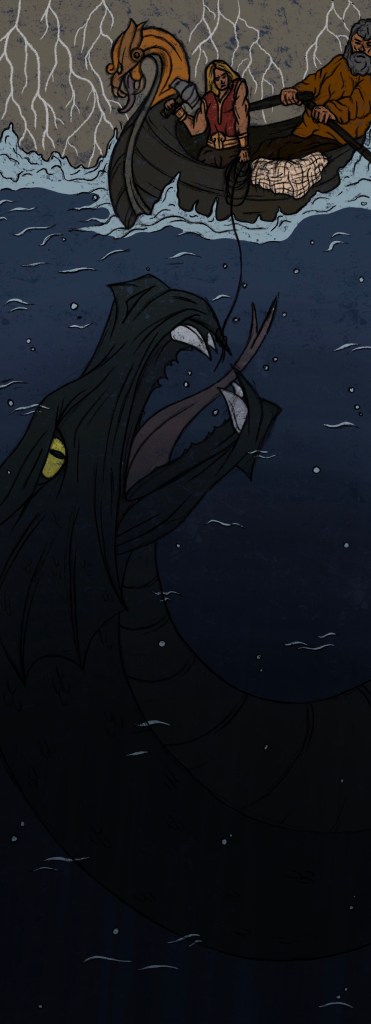
Thor fishing Jormungandr: I made Jörmungandr a less vibrant green and the bottom of the image darker to make Jörmungandr stand out less in the water and be more mysterious. This also makes the eyes and teeth more eye catching.

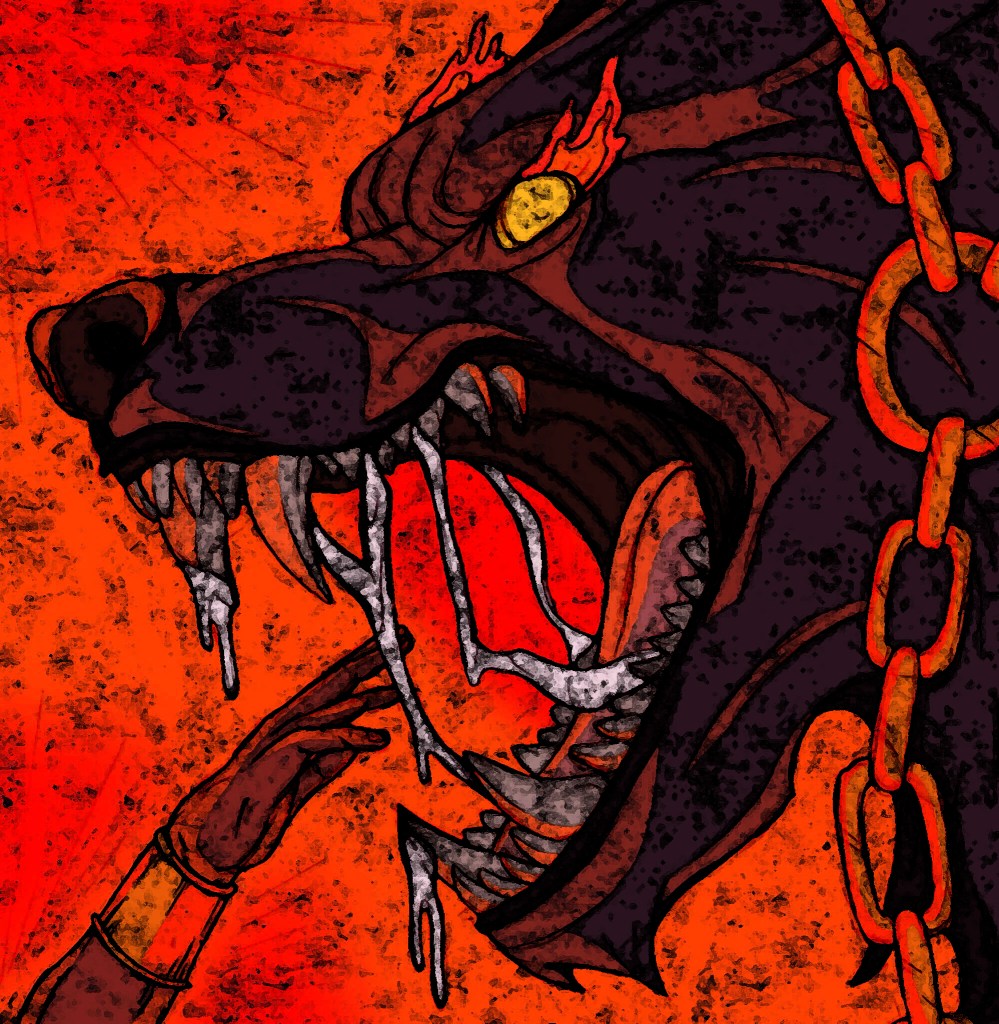
Binding Fenrir: adding in the warm highlights onto the characters really makes the image more dramatic and intense. It also made Fenrir look a lot more menacing and intimidating.

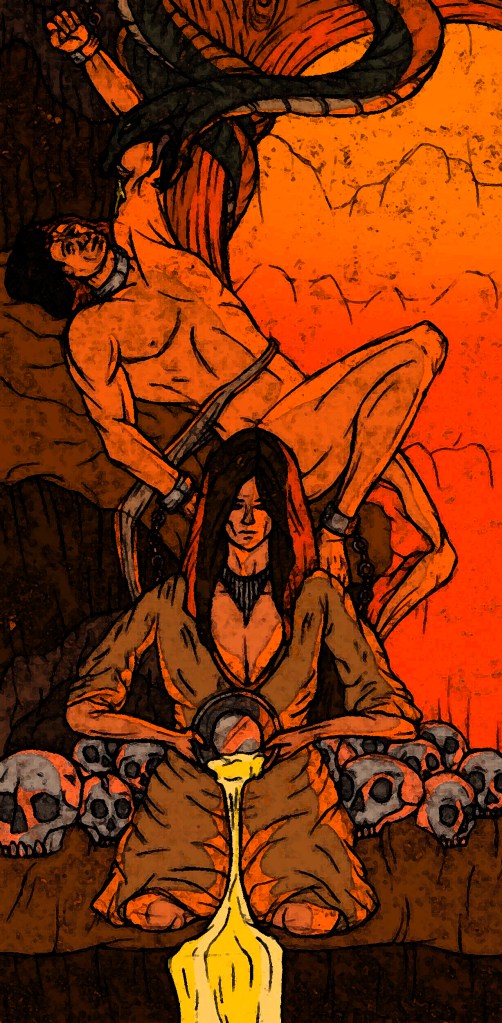
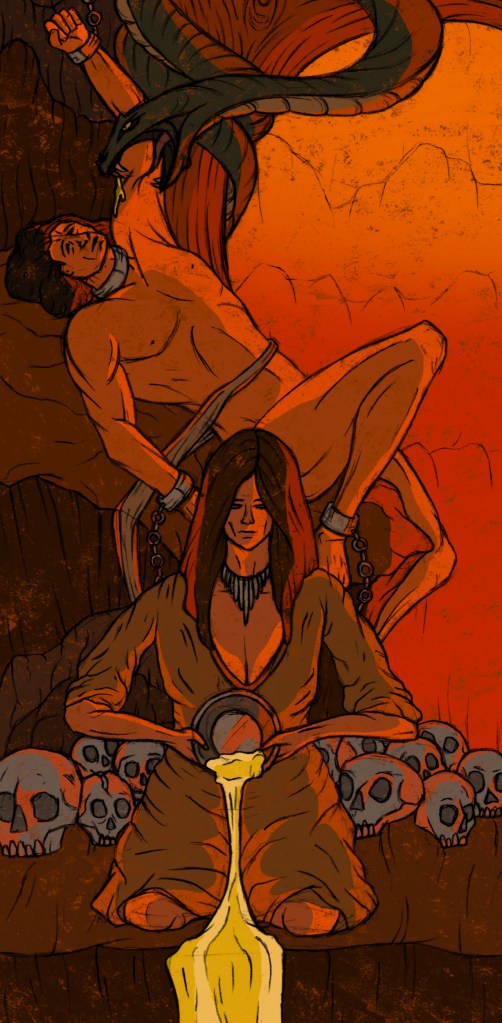
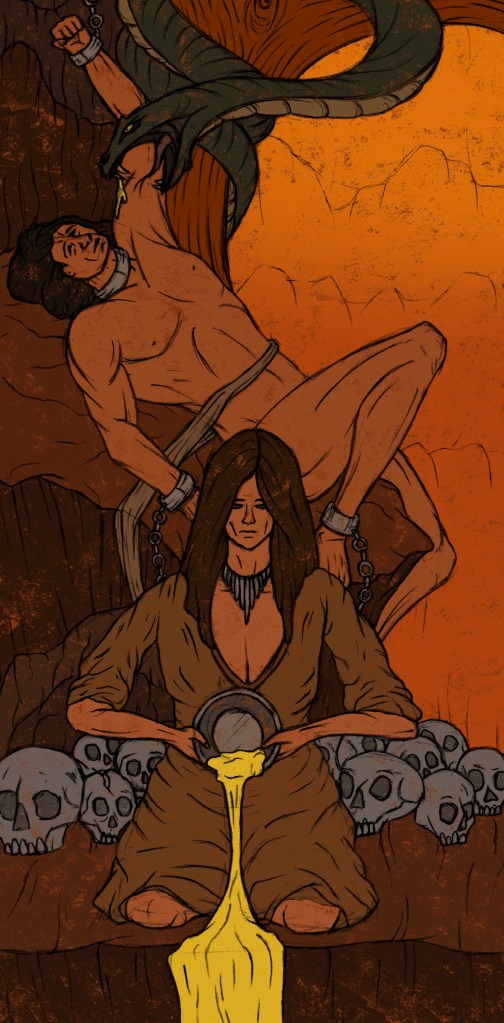
Loki bound: I made the whole composition warmer and added lots of highlights onto the characters and scenery. This now creates an uncomfortable warmth to show the suffering of the characters.

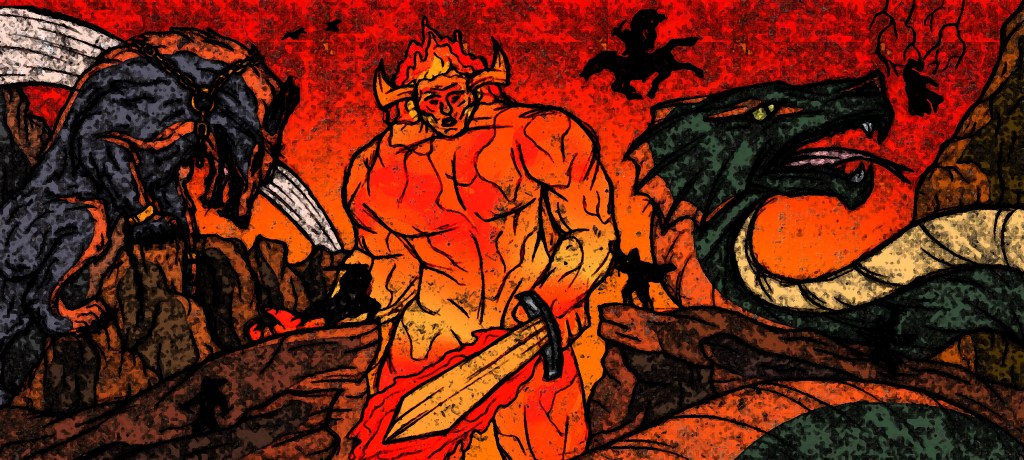
Ragnarok: Surtr now acts as the light source to the whole image. There is a glow from him reflected on all the creatures and scenery. The image now looks a lot more intense and shows the drama of the final battle.

Categories
Contextualised Practice Contextualised Practice: Project Level 5

Contextualised Practice: Colour

Base Colours: I scanned my final sketches and edited them to make them look like they were drawn in pen rather than pencil. To colour my images I used Procreate. I have a large range of brushes I can use and created some of my own textured brushes from the images I made in the creative workshop. This post shows all my illustrations with base colours. Before starting I had a pretty good idea of the colour palette I wanted for each image. I took inspiration from the Norse mythology colour palette which consists of colours found of Norse artefacts.

Creation of the cosmos: this image is divided into 2 distinct sections with different palettes. The top sections is fire so has a very warm feeling and the bottom is ice with a much cooler palette. This contrast is key to telling the Norse creation story. This image needs the 2 parts to merge more so I will add reflections of the fire onto the characters and ice.

Thor fishing Jormungandr: I wanted this image to have a more earthy palette which is why I went for lots of greens, blues and browns. These colours work as a nice and cohesive palette. There are a couple points of contrast that really stand out, the eyes and teeth of Jörmungandr. I want to try emphasise these more to make them more eye catching for the viewer. Another alteration I want to make is to have the bottom of the image darker, to hide Jörmungandr more and make him seem like he’s rising from the depths of the ocean.

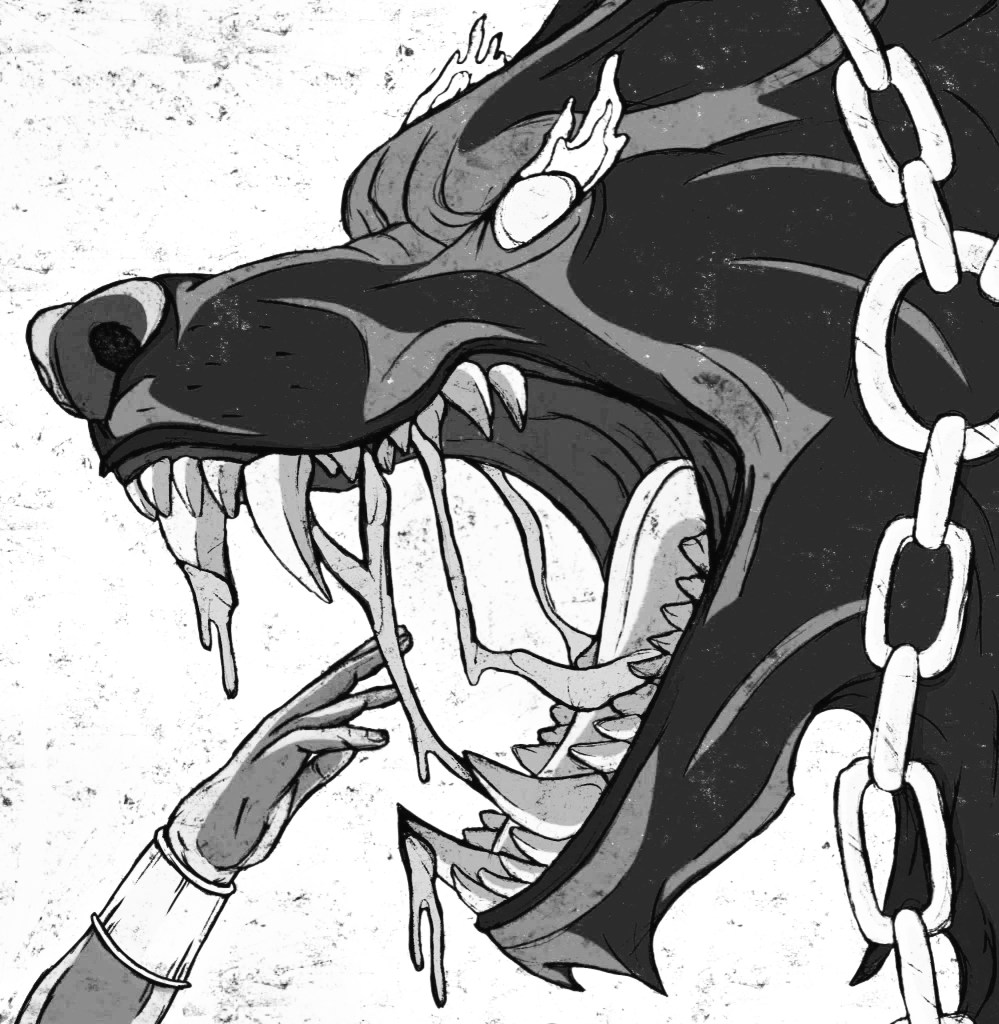
Binding of Fenrir: the contrast between the intense warmth of the orange and the cool tones of Fenrir are really striking. I’m really happy with the colours, the image just needs reflections of the warmth on the characters to much it feel like the heat it surrounding them rather than just behind them. I think this change will significantly improve the design and make it less flat.

Loki bound: the colour palette of this image had the smallest range, mostly just consisting of shades of brown and yellow. I wanted this image to feel almost uncomfortably hot to show the suffering of the characters. The current colours are too muted to really translate this idea. I’ll need to add in more orange and highlights will play a key parts in creating this sense of overwhelming heat.

Ragnarok: this image has the most diverse colour palette. The background a scenery is mostly deep red and a mixture of dark browns. The gods are simple black silhouettes. Each of the creatures has their own colours. I’m happy with this distribution of colour but my main issue with it currently is that it’s generally too dark. It needs more light and warmth radiating from the centre (Surtr) to lighten up the rest of the characters/surroundings.

The next step will be to add in lighting, highlights and shadows to make them all feel more dramatic and visually engaging. This will be a key part in getting across the narrative of the images as at the moment they feel pretty flat and a bit lifeless.

Categories
Contextualised Practice Contextualised Practice: Project Level 5

Contextualised Practice: Developed Sketches

I scanned in my original rough sketches and resized them to fill a piece of A4 paper. Then I printed them and used a light box to trace them in pencil. I used them as references for my refined sketches, making the necessary changes/ improvements. For each illustration I will explain the changes I made and have included a quote from one of the original literary sources that inspired the illustration.

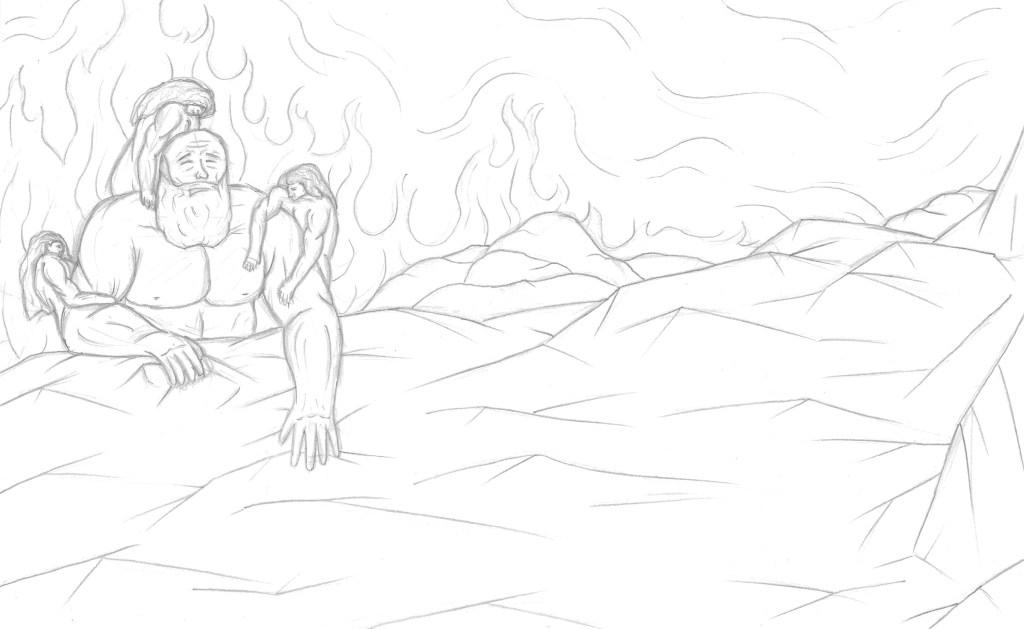
The Creation of the Cosmos: I didn’t make any major changes to this illustrations, except making the image slightly longer and thinner. Other than that I just improved on the sketch, adding in more details to the characters, fire and ice.

Quote from the Poetic Edda:

“Of old was the age | when Ymir lived;

Sea nor cool waves | nor sand there were;

Earth had not been, | nor heaven above, But a yawning gap, | and grass nowhere.”

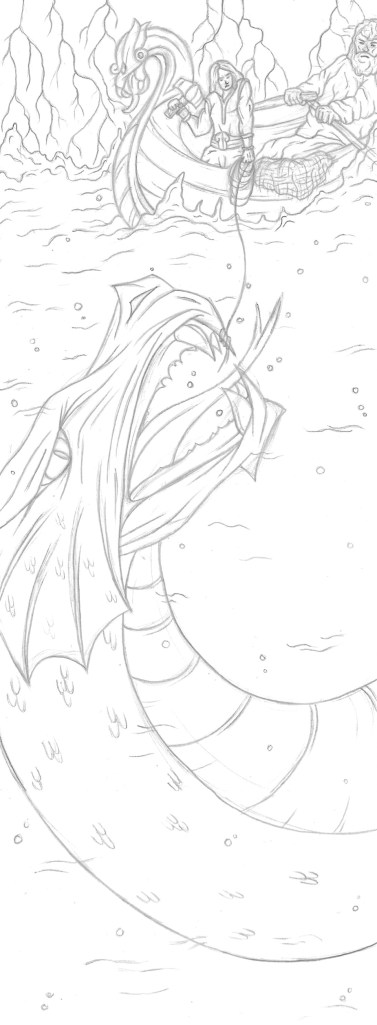
Thor fishing Jormungandr: the concept of the image remained the same but I did make a couple of key changes. One thing I removed was Jörmungandr wrapping around the ship as it didn’t flow nicely with the rest of the composition and took away from the sense that he was coming from the depths of the sea. Also I significantly extended the image, making it a lot longer and therefore appearing thinner too. This was to show more of Jörmungandr and really emphasise how monstrous he is. Other that than I just improved on the sketch, adding more details to the characters, boat, sea and sky.

Quote from Prose Edda:

“the squamous serpent squirms with rage”

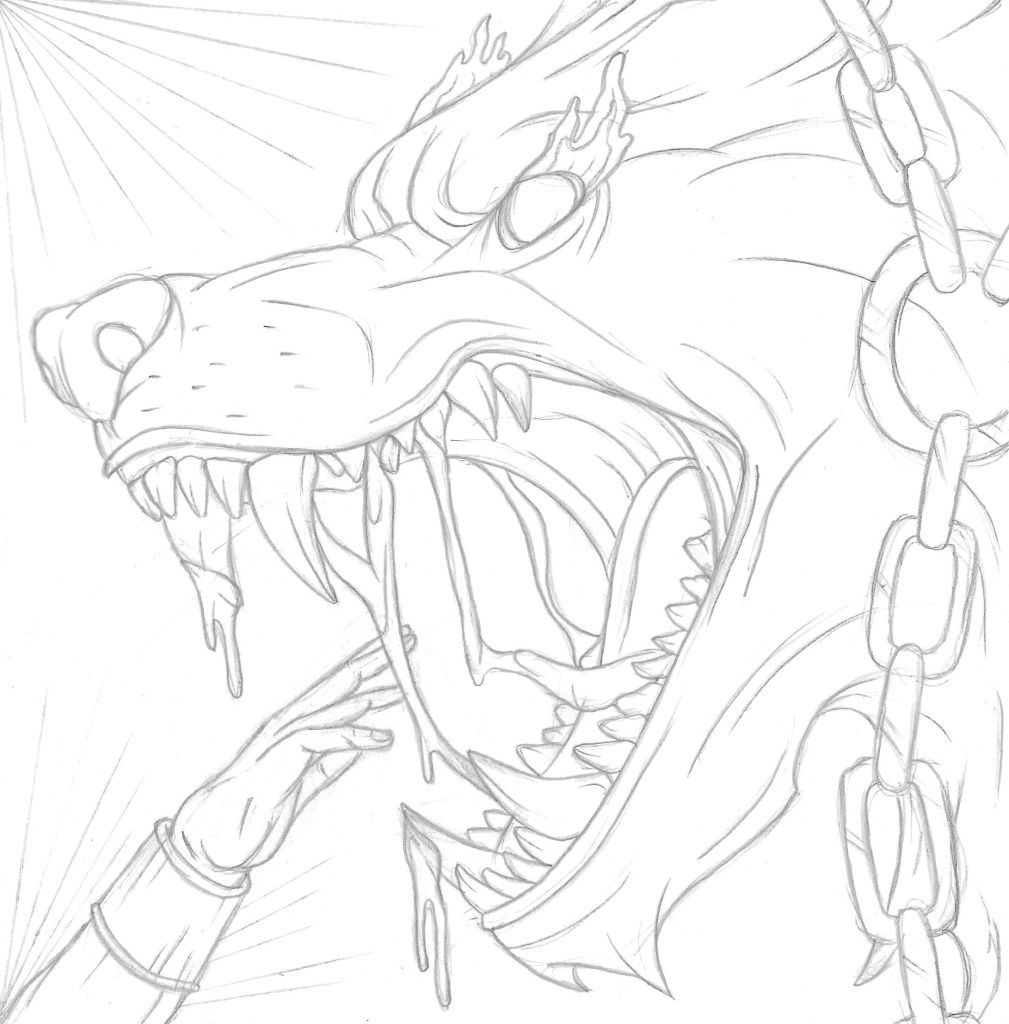
The binding of Fenrir: No drastic changes were made to the concept or composition, I just improved on the drawings of the hand and Fenrir. For the hand I used a photo of my own hand for reference, making sure that it was very small in comparison to Fenrir’s mouth to emphasised the imbalance of power/strength. To draw Fenrir I used reference photos of wolves to help me get the proportions are forms right. I’m really happy with the sketch and this it improved significantly from the original one with the most important detail being the increase in size of Fenrir’s mouth.

Quote from Prose Edda:

“They wanted the wolf to try this also,

Saying to him that he would become very famous for his strength,

If so strong a chain was not able to hold him.”

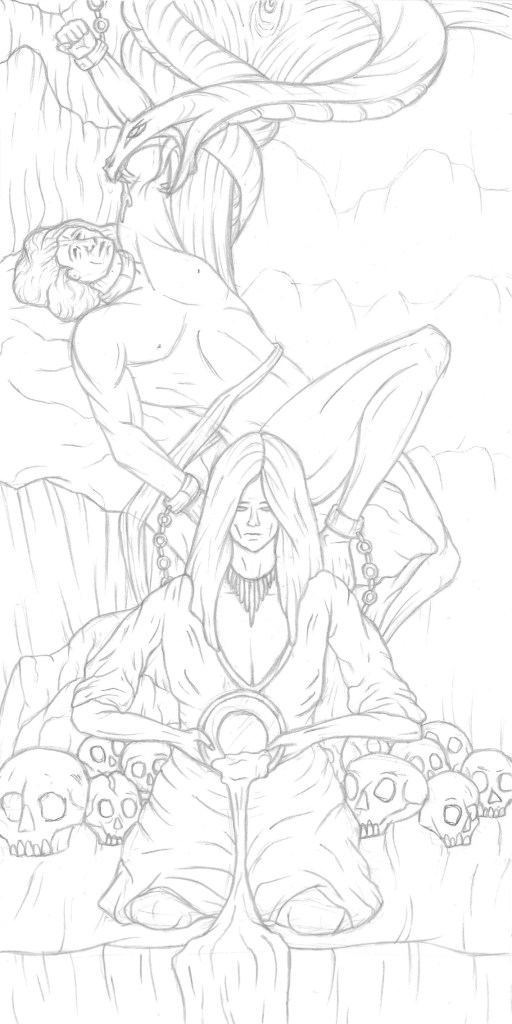
Loki bound: the only major change I made for this one was extending the image to make it longer and thinner. This is because I felt showing all of Skadi and being able to see where she was pouring the venom allowed for a more interesting and complete image. Also I wanted it to have similar dimensions to the Jörmungandr image. I also improve on the sketch, focusing on the people and making sure the proportions where correct.

Quote from Völuspá:

“I see one in bonds by the boiling springs;

Like Loki he looks, loathsome to view:

There Sigyn sits, sad by her husband,

In woe by her man. Well would you know more?

From the east through Venom Valley runs

Over jagged rocks the River Gruesome.”

Ragnarok: I didn’t make any major changes I just refined the details. I improved the sketches of all the creatures and silhouettes of the gods. I decided to limit the number of gods I had so there was more emphasis of the ones that are key to the story. I did make the image slightly longer and thinner to match the creation story illustration and make it feel more like a traditional battlefield image.

Quote from Prose Edda:

“From the south comes Surt

With blazing fire- brand,

The sun of the war god

Shines from his sword.”

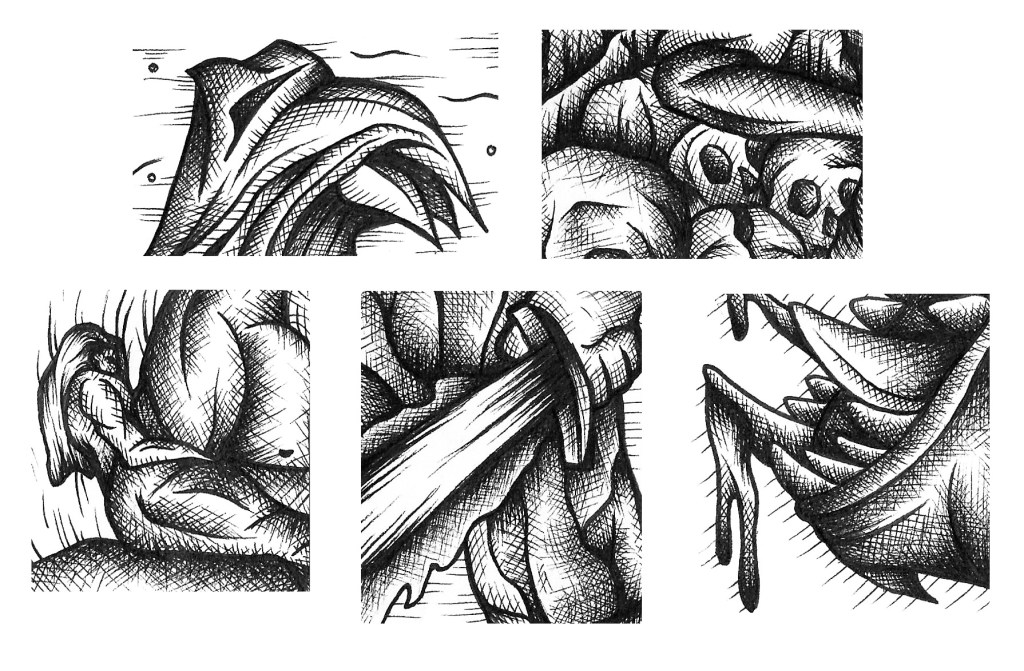
Hatching sections: one of the mediums I’m going to use for these illustrations is hatching and pen shading. I did some experiments with different styles of mark making and found that I like using straight line hatching for shading with a pen. Here is 1 section from each image that I did completely in this style:

I’m really happy with the finalised sketches and think that the changes have significantly improved the images. The next step for this project will be to scan my final sketches and take them into Procreate to begin adding colour.

Categories
Contextualised Practice Contextualised Practice: Project Level 5

Contextualised Practice: Essay Development

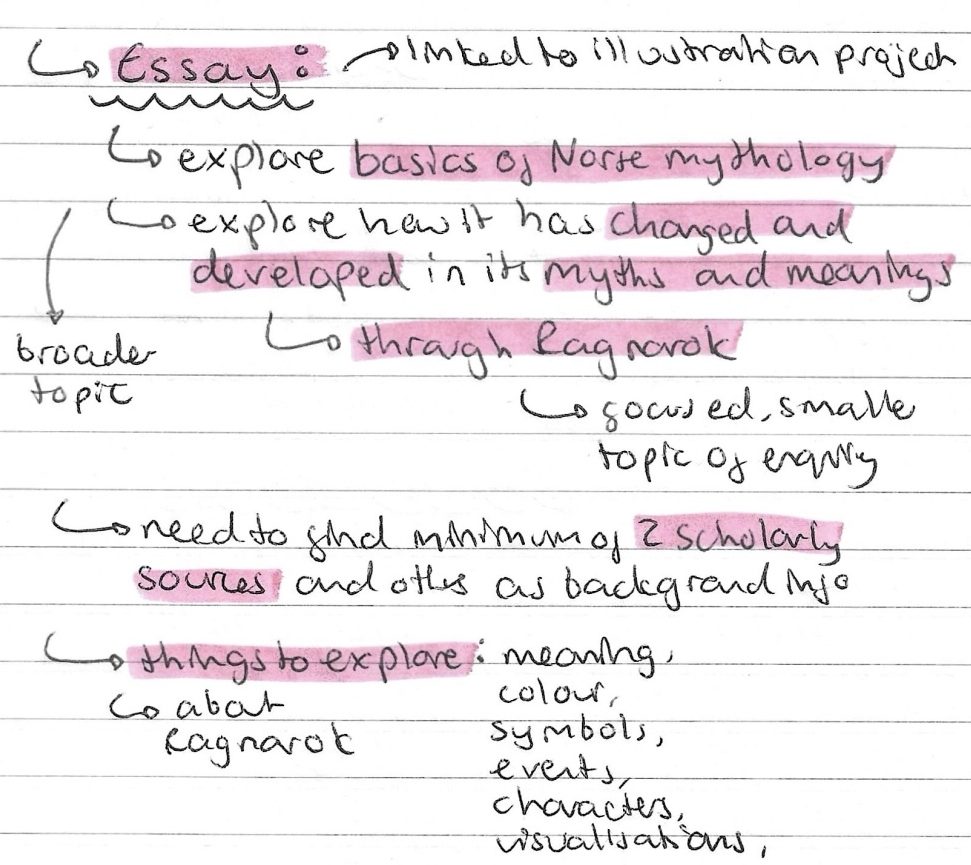
Earlier in the semester I made a list of potential essay questions linked in Norse Mythology and from this I narrowed down the topic I wanted to write about. I haven’t got an exact title as of yet but I decided I want to base it around how Norse Mythology has changed and developed over time. As it’s only a 2000 word essay I had to narrow down the topic of enquiry so I have chosen to centre it around Ragnarok. This is one of the most well known and interesting Norse myths so there are lots of sources to look at and reference. In the illustration project I’m creating an illustration of Ragnarok so it goes hand in hand with this. Through the research I’ll do for the essay I’ll be able to create a more interesting depiction of Ragnarok.
I began to make a plan for my essay, thinking about sources and structure:

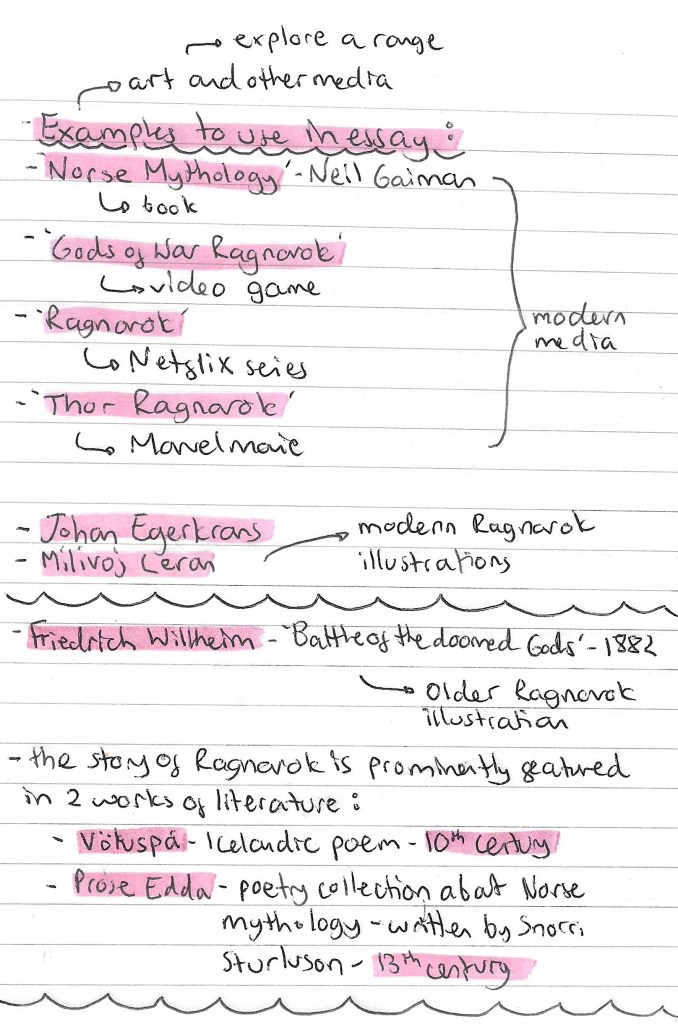
Here is a list of sources that I could reference in my essay, ranging from the earliest written sources to modern pop culture adaptations. As I’m looking at how it’s changed and developed I need to reference sources from different time periods. I think it’ll make for an interesting comparison and discussion.

Modern pop culture:

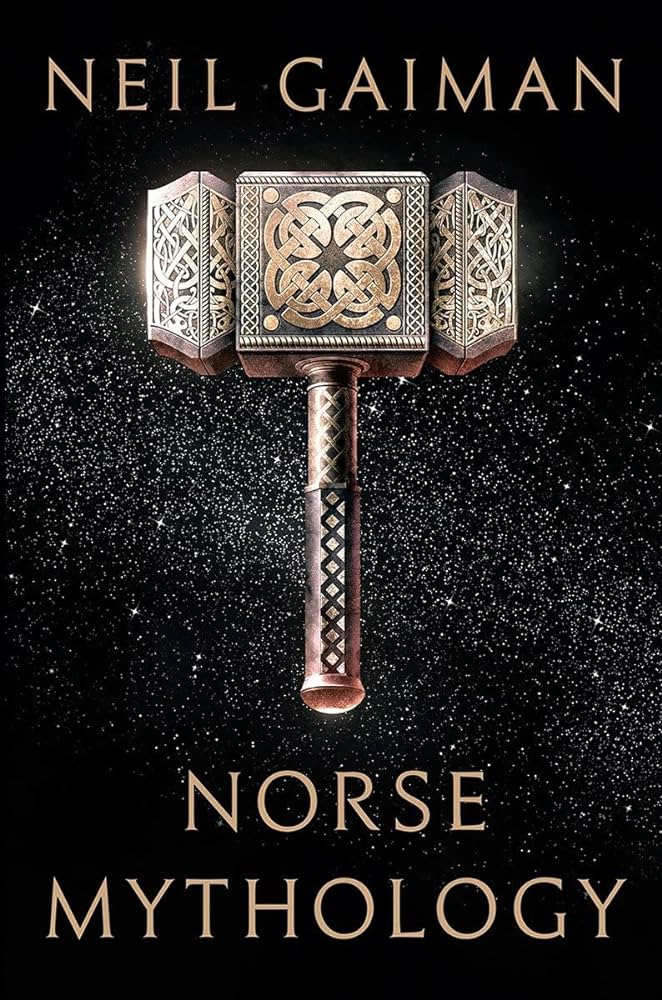
Norse Mythology- Neil Gaiman (book):

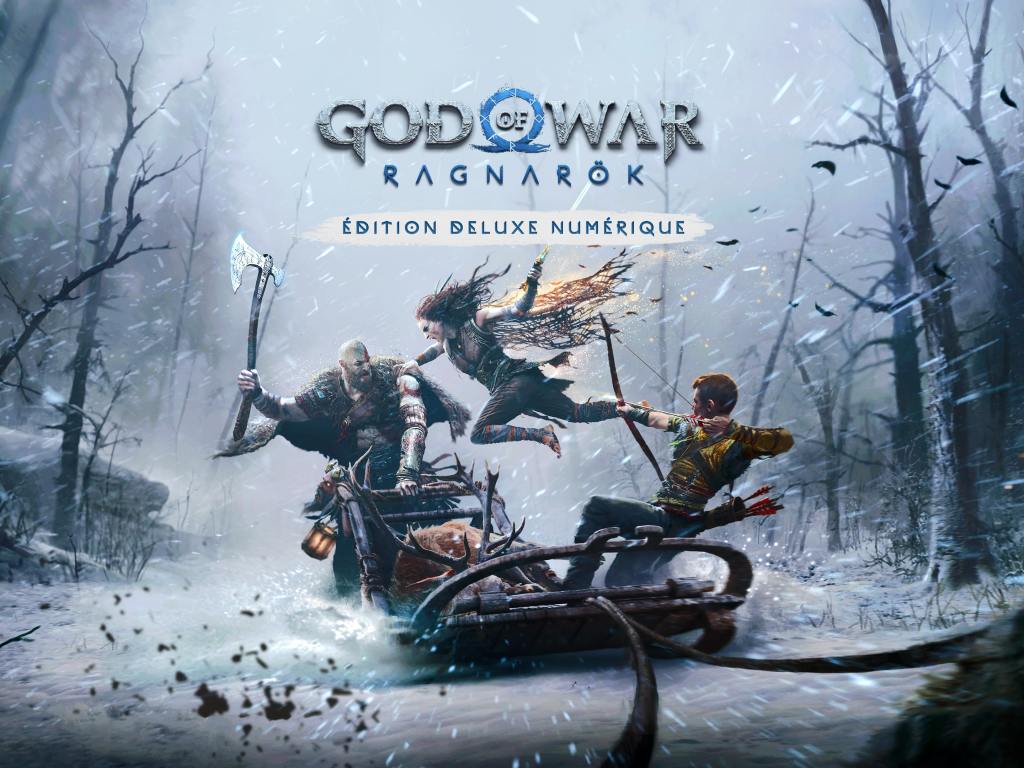
Gods of War (video game):

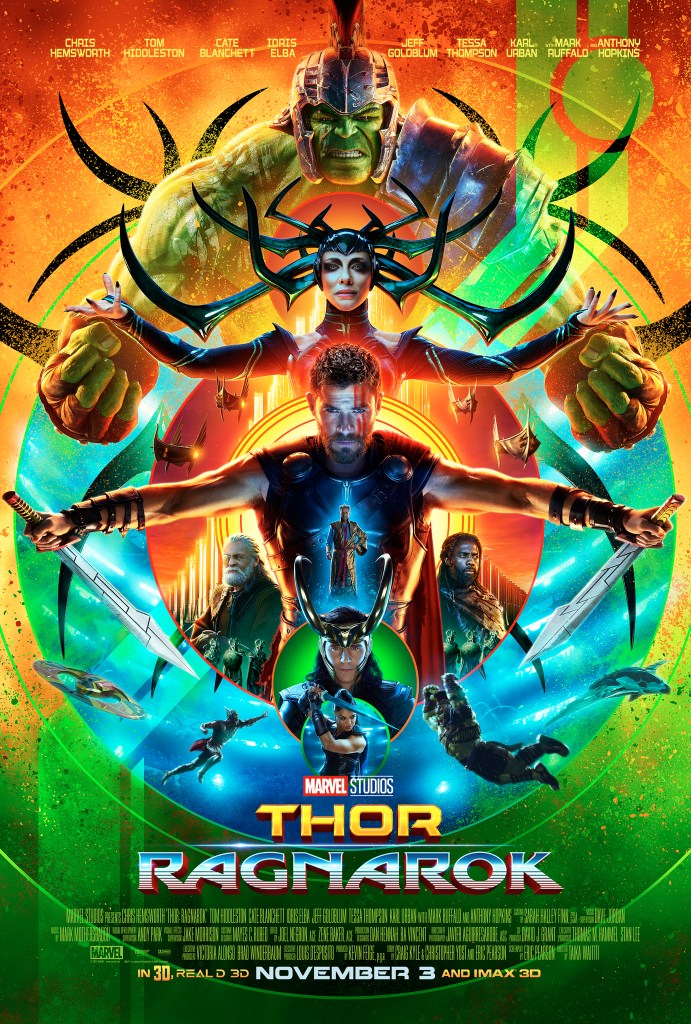
Thor Ragnarok- Marvel (movie):

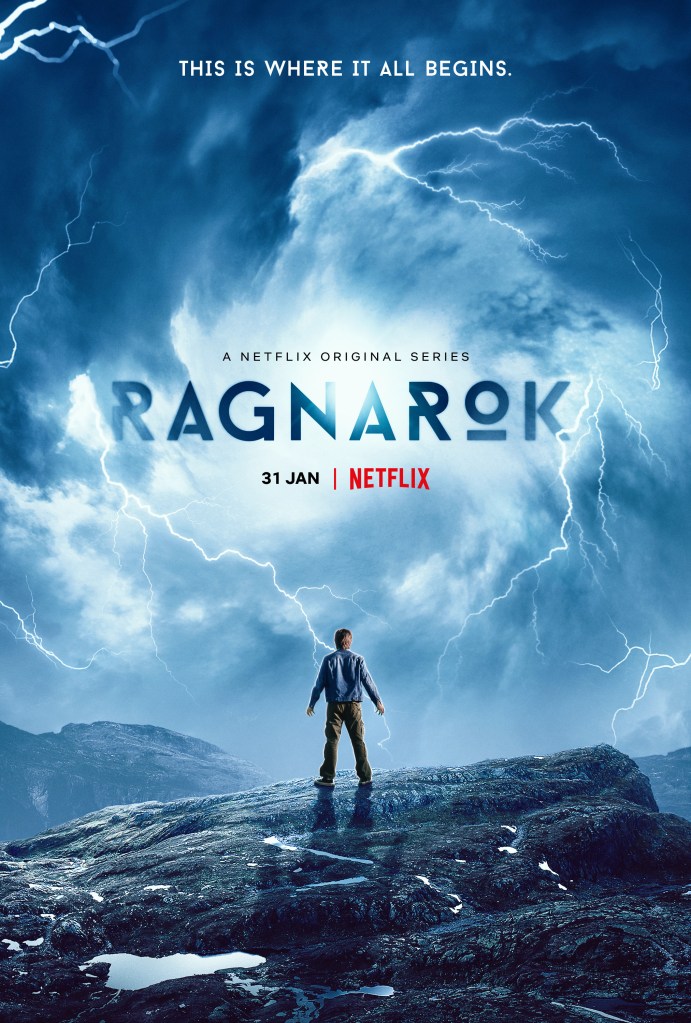
Ragnarok- Netflix (series):

Illustrations:

Johan Egerkrans:

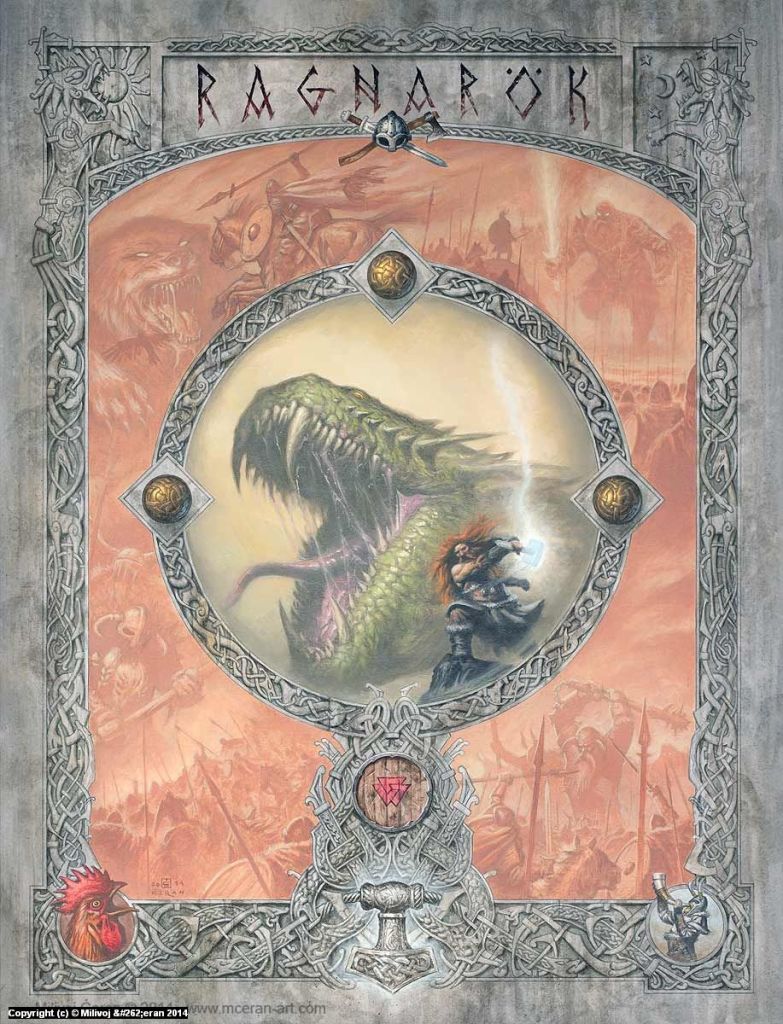
Milivoj Ceran:

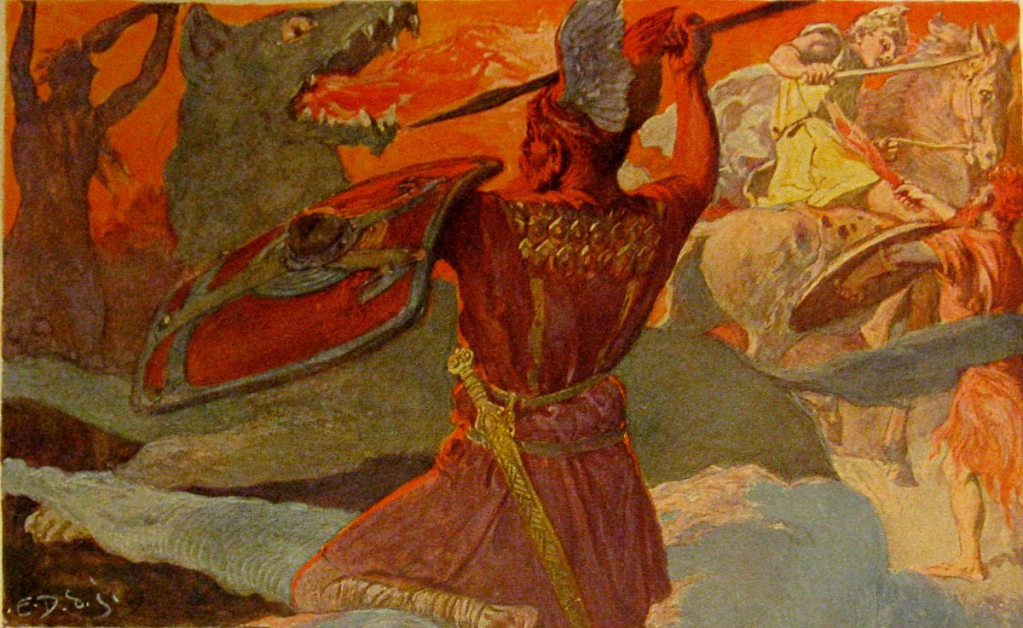
Emil Doepler (paintings):

Friedrich Willheim:

Original source:

Prose Edda, Poetic Edda, Voluspa:

Categories
Contextualised Practice Contextualised Practice: Project Level 5

Contextualised Practice: Riso Printing Induction

After researching different printing techniques I decided that I wanted to use Riso printing for my Norse mythology illustrations. As I had never used the Riso printer before I had to book in for an induction. Before the induction I did some research to learn a bit about Riso printing so I would have some basic knowledge going into the induction. Some interesting things I learnt can be seen below:

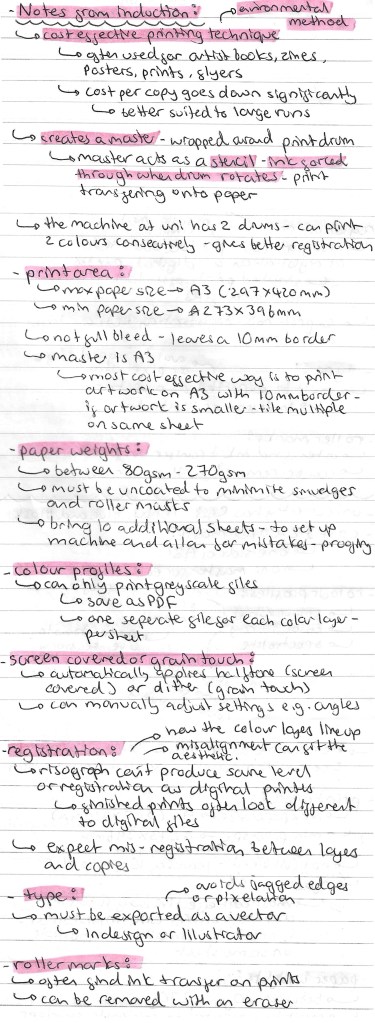
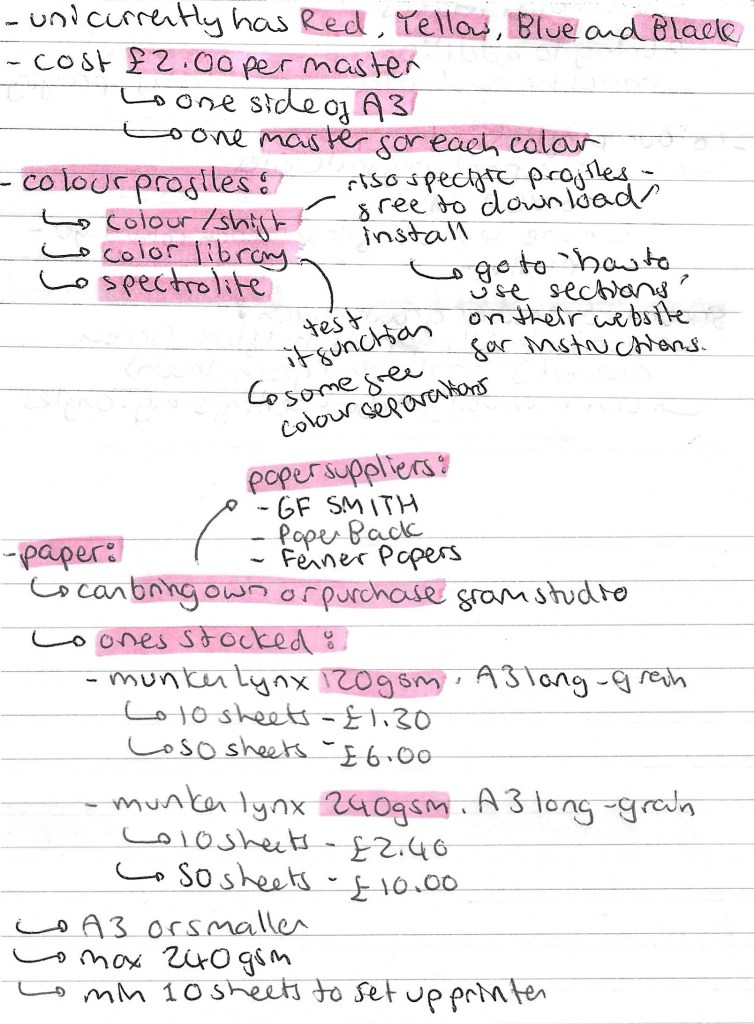
Notes from induction: including information on costs, creating a master, printing size, paper weight, colour profiles, texture and registration:

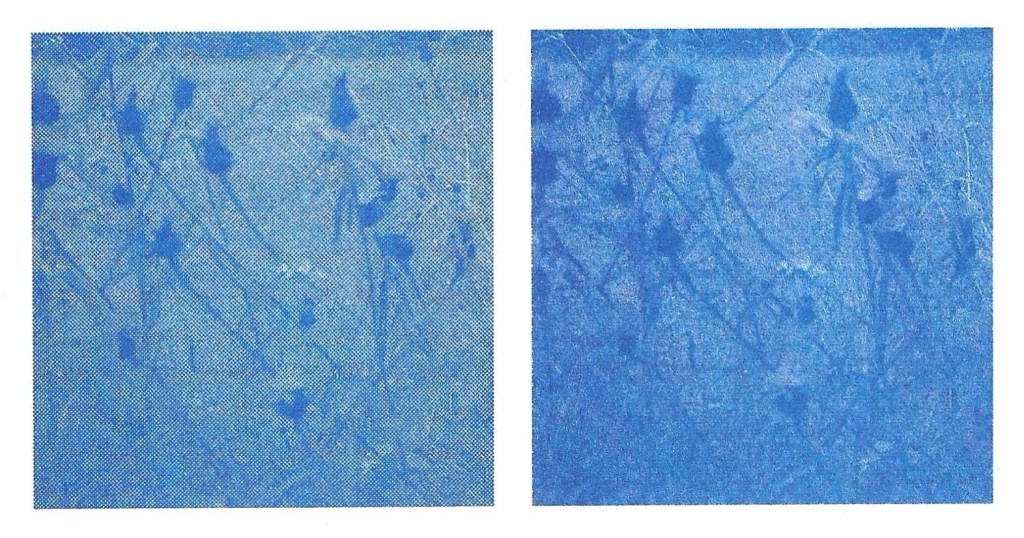
Printing texture: Riso printing can achieve 2 different textures, halftone/gain touch (left) or screen covered (right). The specific settings of these can be adjusted to achieve different looks. In my printing I’d like to experiment with both textures. Below is a comparison of the 2 types:

Colour Profiles: Riso prints each colour layer separately. To do this you need to convert the image into a series of different colour profiles. To get a full colour prints you need to layer up the different colours. The image below shows a blue, red and yellow print which combined make a full colour print:

Colour charts: the university has a limited selection of colours to use for Riso printing. The options are black, red, blue and yellow. I will experiment with using different combinations of these colours for my printing. Below are all the different colours that you can achieve by using combinations of the 4 available colours:

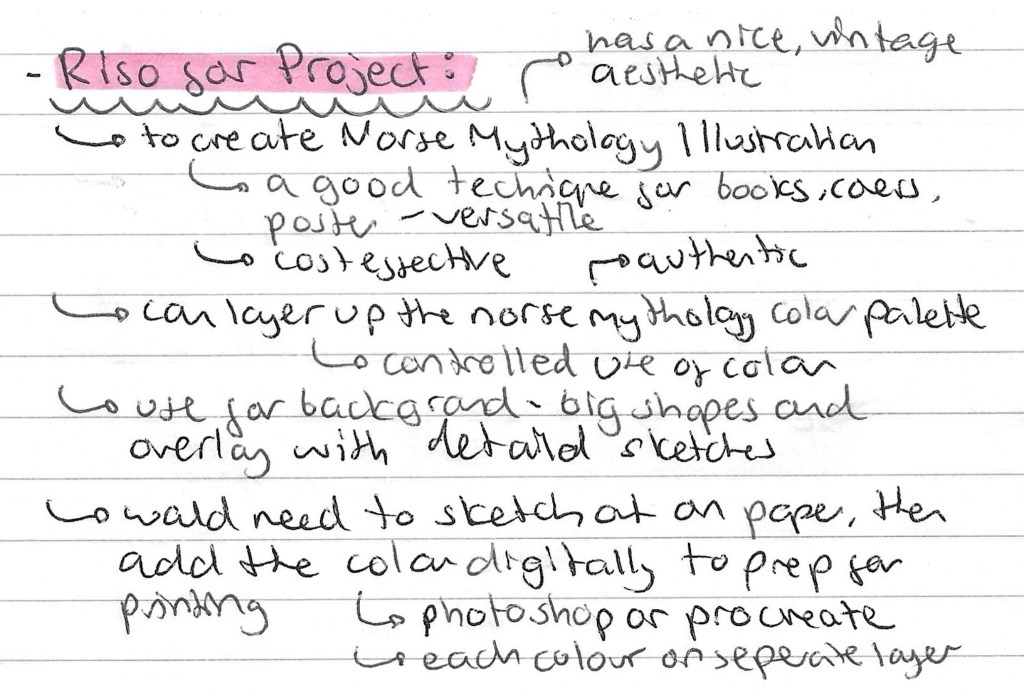
Riso for project: I will be using Riso printing for my project as it has a nice, vintage aesthetic also it’s a versatile and cost effective printing technique. Riso printing allows for a precise control over colours so I will be able to layer colours to achieve my desired palette. I will combine the printing with pen hatching/shading. The next step is to make refined sketches on appear and then digitally add colour. By doing it digitally it allows me to separate the colours onto different layers, making it easier to create the colour profiles needed for Riso printing.

Categories
Contextualised Practice Contextualised Practice: Project Level 5

Contextualised Practice: Initial Sketches

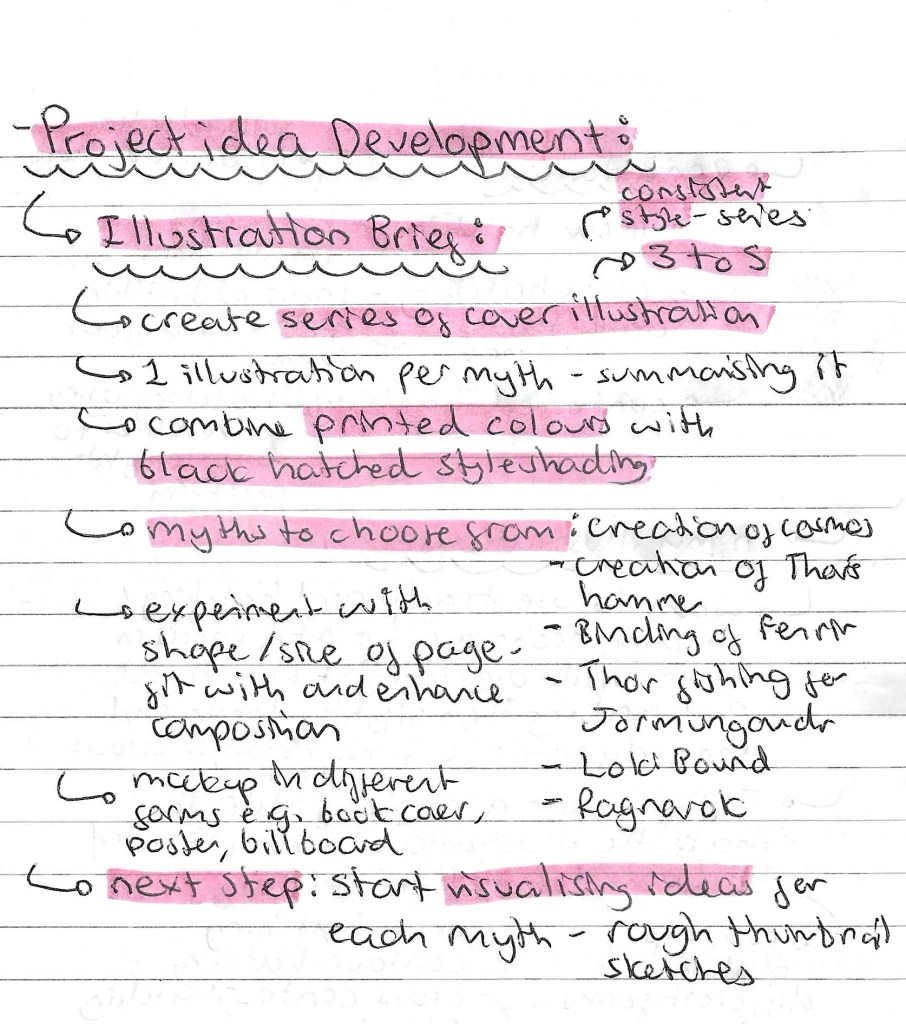
This summarises my most up to date plan for the project. I chose 5 myths to illustrate as I wanted the series to have an odd number and felt 3 wasn’t enough to really explore the topic. The 5 are all the myths I researched except the creation of Thor’s hammer. I decided to remove this one as it was the it was less character based and I wanted to work mostly with the gods/goddesses and creatures.

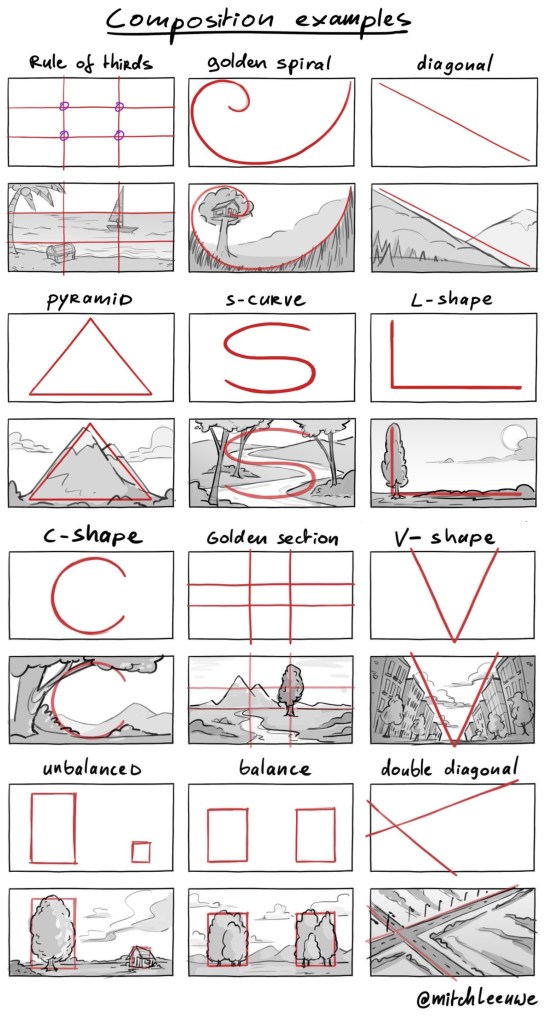
Compositions: I really wanted to explore composition in these illustration by varying the shape/ size of the image and the compositional shape. Lots of the examples of Norse mythology art that I liked had really interesting compositions, playing with balance and sizing.

Thumbnail sketches: these are quick thumbnail sketches I made for each myths. I used these as a way to get my ideas onto paper and made some notes about the ideas for each. Using thumbnail sketches is a great way to quickly visualise your plan for an image, it’s a step I almost always use in my creative process. After sketching these I then review them and draw more resolved images for each with the necessary changes.

Here are my more refined sketches, in chronological order of the myths:

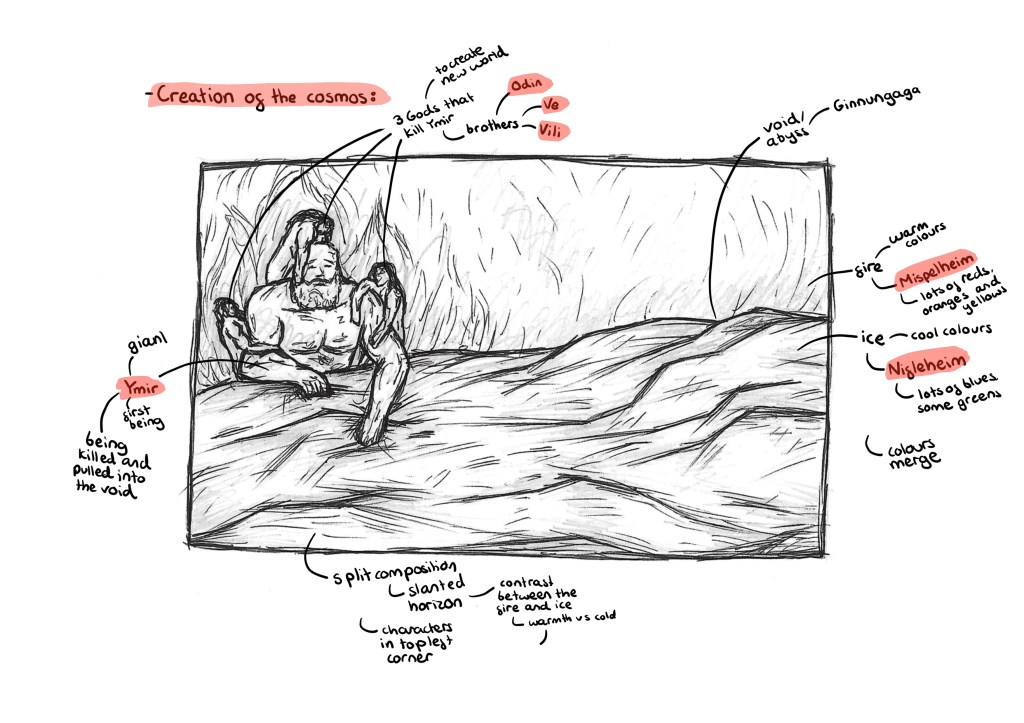
Creation of the cosmos: this image illustrates the Norse creation story. In the background will be fire, representing Mispelheim and in the foreground will be ice, representing Nifelheim. These 2 worlds cross the void/abyss, called Ginnungaga, and collide. On the left on the image there are 4 characters. The large one being Ymir, a giant who is said to be the first living being. The 4 smaller ones are 3 gods, Odin, Ve and Vili. The 3 brothers kill Ymir and construct the cosmos from his corpse. In my image they are dragging him into the void between the 2 worlds so it depicts the moments before they kill Ymir and build the cosmos. I want a split composition with a slight slanted horizon line. The colours will really emphasise the contrast, with cool tones in the foreground and warm tone in the background. The image will be unbalanced, with all the characters on one side. I made this decision as I want to draw the viewers eye to this section and then make them notice how much empty space there is. This is to try empathises how these are the only beings alive at this time. In terms of image dimension I want it to be slightly longer and thinner than A4 to get across the vastness the creation story.

This is an image that really inspired me. I want to keep the split composition but make there more of a balance between the ice and fire and a slanted horizon line. Also I will put all the characters to one corner, drawing the attention to the drama. I want to use a more intense version of the colour palette seen here.
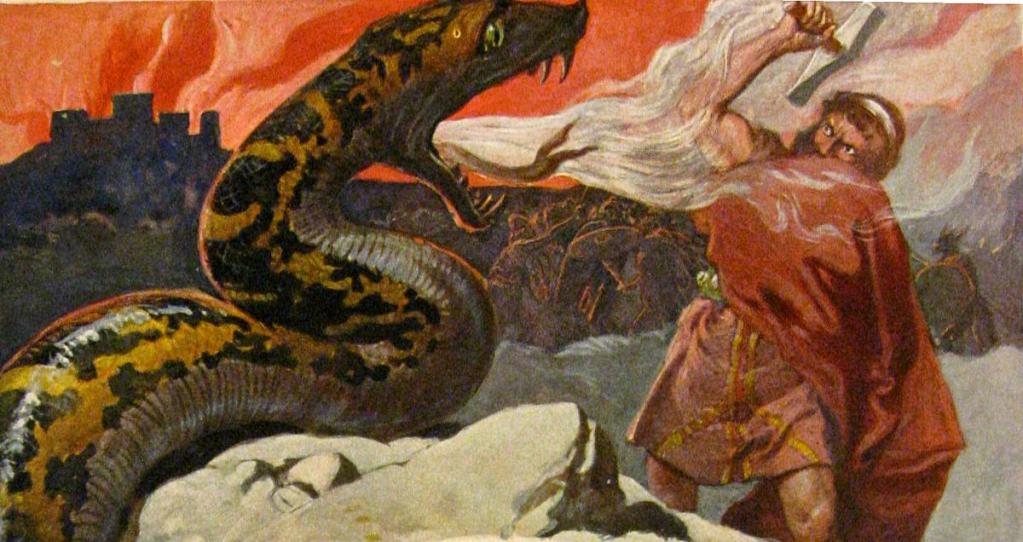
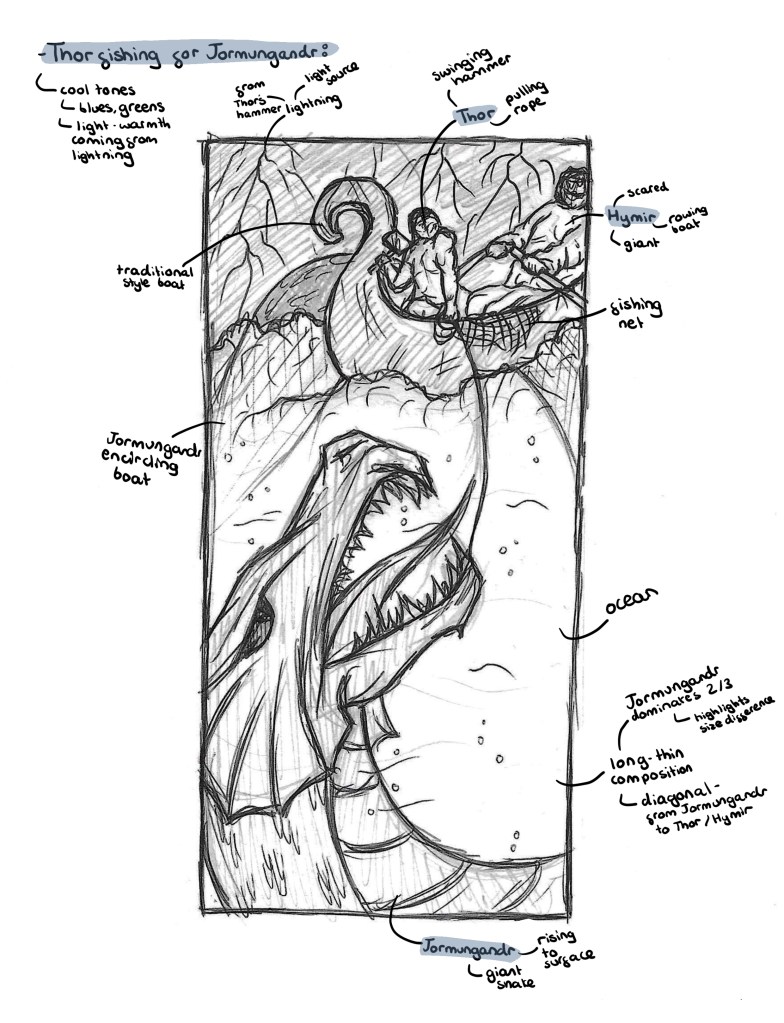
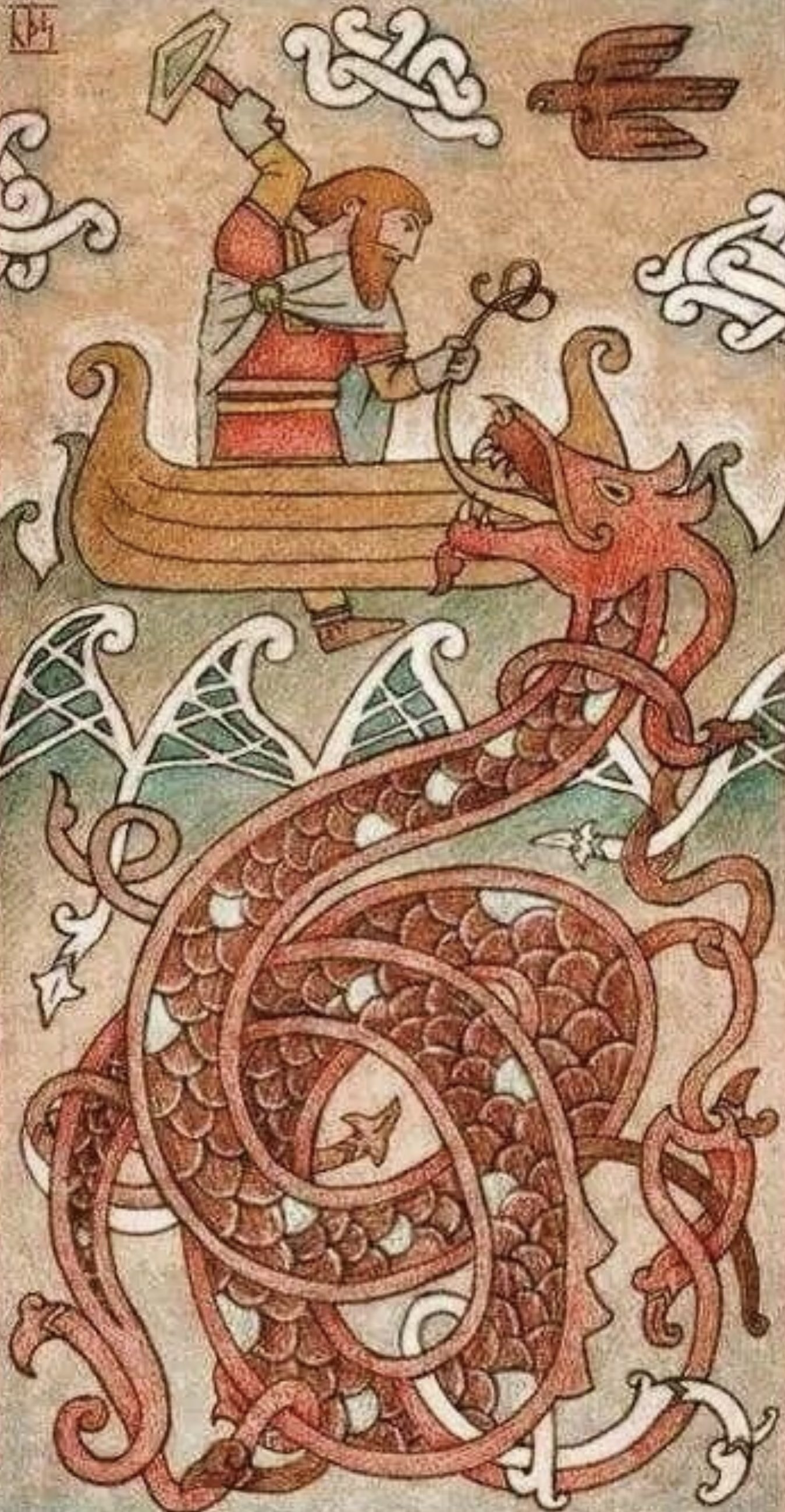
Thor fishing for Jörmungandr: this image shows the story of Thor and Hymir going on a fishing trip. The pair went out on a small boat to catch some fish for their village. On their journey they caught what they assumed to just be a large fish but ended up being Jörmungandr who got caught on the wire. Thor and Jörmungandr had been long time foes so Thor wanted to kill him but Hymir wanted to sail away. My image is divided into 2 uneven sections by the water horizon line, a small top section and a large boots section. At the top there are Thor and Hymir in their small, traditional Viking boat. Thor holding Mjölnir and the fishing line, wanting to attack and Hymir trying to sail away. In the bottom section is the head of Jörmungandr, I want to make the saves unbalanced to get across how large and dangerous the Midgard serpent is. Jörmungandr is rising to the surface ready to attack so th image is just after he gets caught on the line and before he rises out the water. I wanted to capture this moment so there’s suspense. The image size helps with this as it’s a long, thin shape, allowing the snake to dominate most of the space. For the colour I’m thinking earthy tones with lots of blues and greens. I want the lighting from Thor’s hammer to be a light source and to have Jörmungandr partially hidden by shadows to make him more ominous.
I drew inspiration from this image, with the position of the characters and shape of canvas. However, I want to completely change the colour palette and make the image more dramatic. Jörmungandr will be much larger in comparison to the other characters. Also Jörmungandr will not yet have come out of the water. I think it’s important to have Hymir in the scene as he plays an important role and is often overlooked in illustrations.

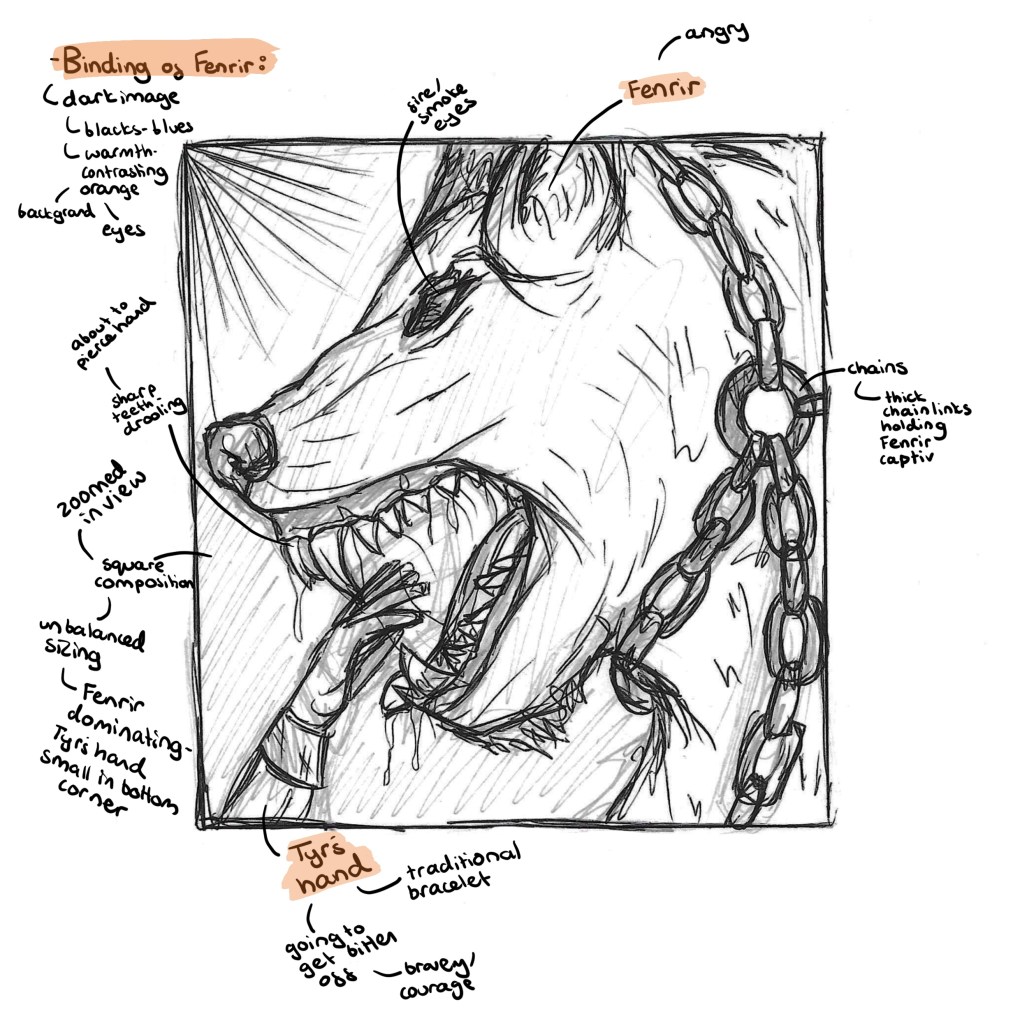
Binding of Fenrir: this image is about when the gods had to try to bind Fenrir. Fenrir was getting too big and powerful so the gods decided they had to lock him up. To do this they tricked Fenrir into thinking it was a game of strength. Each time they would put a chain around him and say it was a test to see if he could break it, eventually hoping they would put one that couldn’t be broken. Fenrir grew suspicious and said he would only play along if someone would put their hand in his mouth. To gain this trust Tyr put his hand in Fenrirs mouth knowing it was going to get bitten off. This is a story of sacrifice and bravery. Most of the image is taken up by Fenrir. Some details I want to include are a big chain around his neck and fire coming from his eyes. In the bottom left corner will be the hand of Tyr in the mouth, just before Fenrir snaps his jaw shut. I want to use a contrasting palette with bright warm tones in the background reflecting off the cool toned characters. This will portray the intensity of the situation. The image will be square shaped, I chose this balanced shape so that the unbalanced sizing between Fenrir and the hand will be more striking. This image will be very zoomed in only showing Fenrirs head and Tyrs hand so its really highlighting the details to emphasise the danger.

I was inspired by this piece but wanted to change a few key elements. I want it much more zoomed in as I feel it looks less intense when everything is shown. Also I wanted to incorporate a really bold, contrasting colour palette. This image shows the moment Tyrs hand is bitten, in mine I want to show a couple seconds earlier to really get across the power and size of Fenrirs jaw.

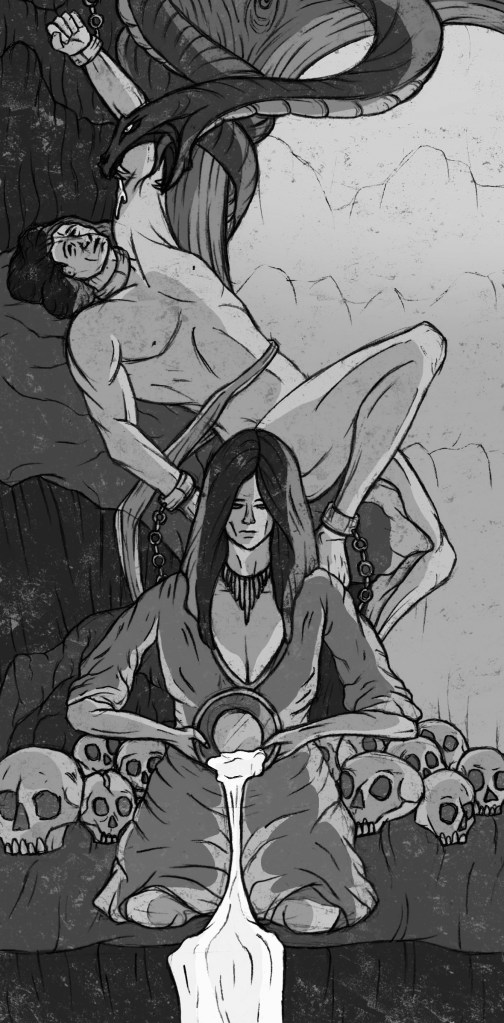
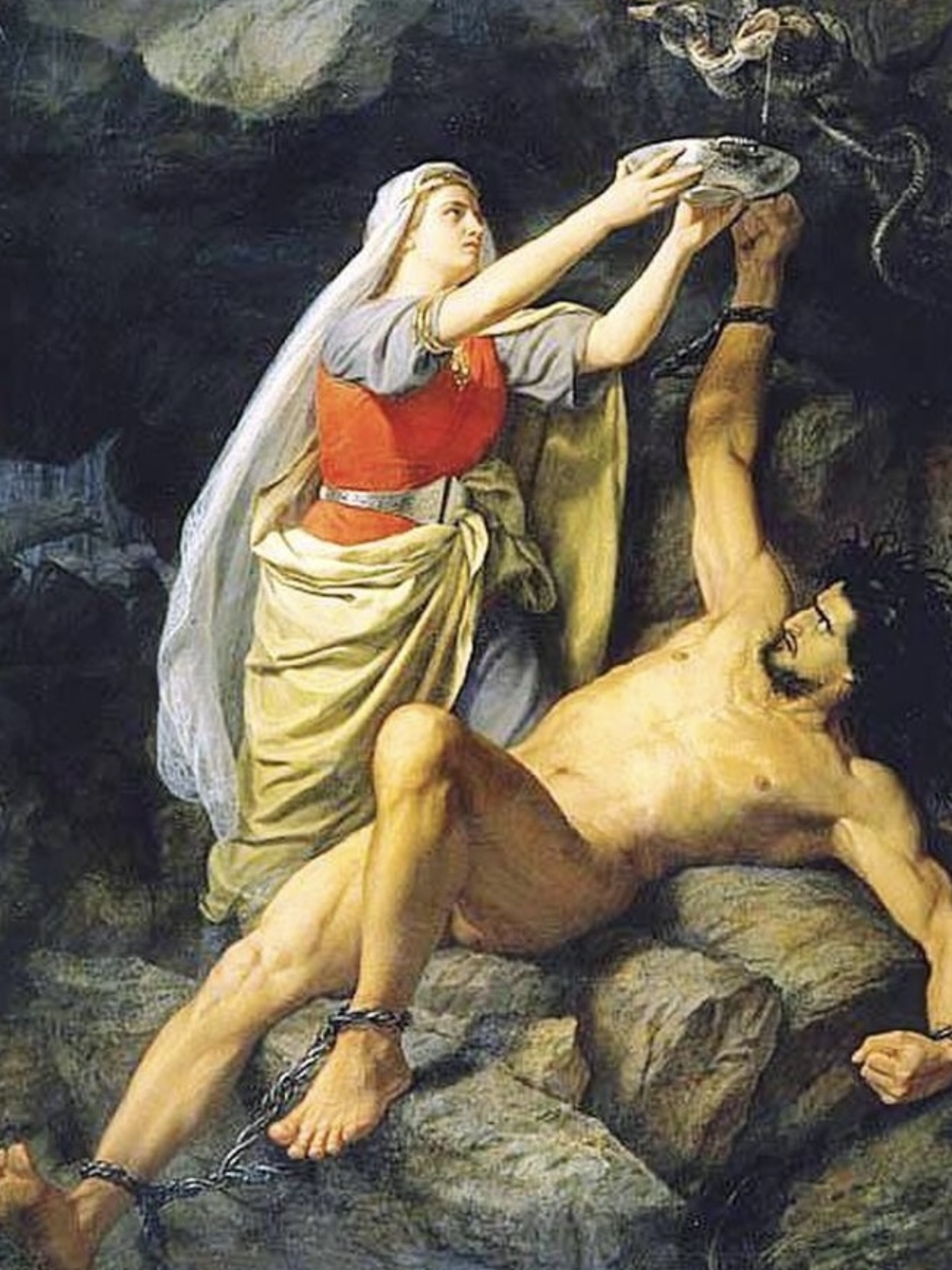
Loki bound: this image tells the story about Loki being imprisoned. Loki was part of the plot to kill Baldur so the gods decided they needed to capture him. Loki ran far away but was eventually found and captured by Odin. He is then chained to the rocks and has a venomous snake placed above his head. His wife Skadi holds a bowl over his head to catch the venom but when the bowl gets full she needs to go pour it away. This is when the venom falls on Loki causing his to shake violently. He remains here until Ragnarok. I’m going for a layered composition with 3 key parts. In the background is a vast desert. The middle has Loki tied to some rocks with the snake wrapped around a tree, hovering over his face. In the foreground is Skadi pouring away the bowl of venom, surrounded by skulls. I want Skadi to be in the front and centre as she is key to the myths as a symbol of loyalty and unconditional love. I want the palette to be very warm, with lots of intense yellows and oranges. The feel I want t.o achieve is uncomfortable heat, to show the drama of the situation. I want the image to have a long, thin size to mirror the Thor fishing Jörmungandr image. Also I want the viewer to see Skadi at the bottom first then their eyes to move up and notice Loki’s situation with the snake.

I will be taking lots of inspiration from traditional paintings of the myths, for example the one below. The changes I will make are to make the snake bigger and more intimidating and show Skadi pouring away the venom, not collecting it from over Loki’s face. This way there is more drama in the illustration as any second now the venom will hit Loki. Another thing I want to change is the colour palette, making is far more warm and intense as I feel the colours below don’t translate the severity of the situation.

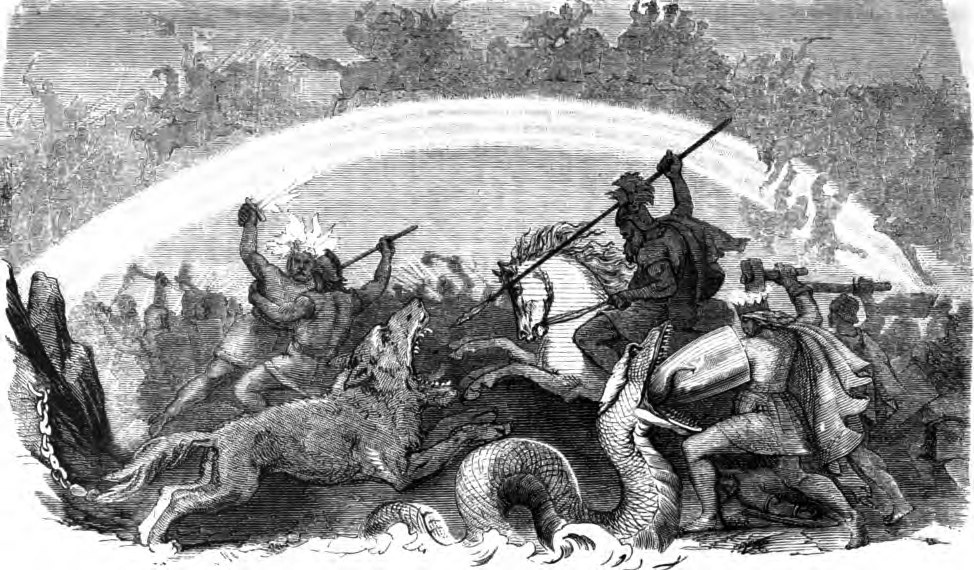
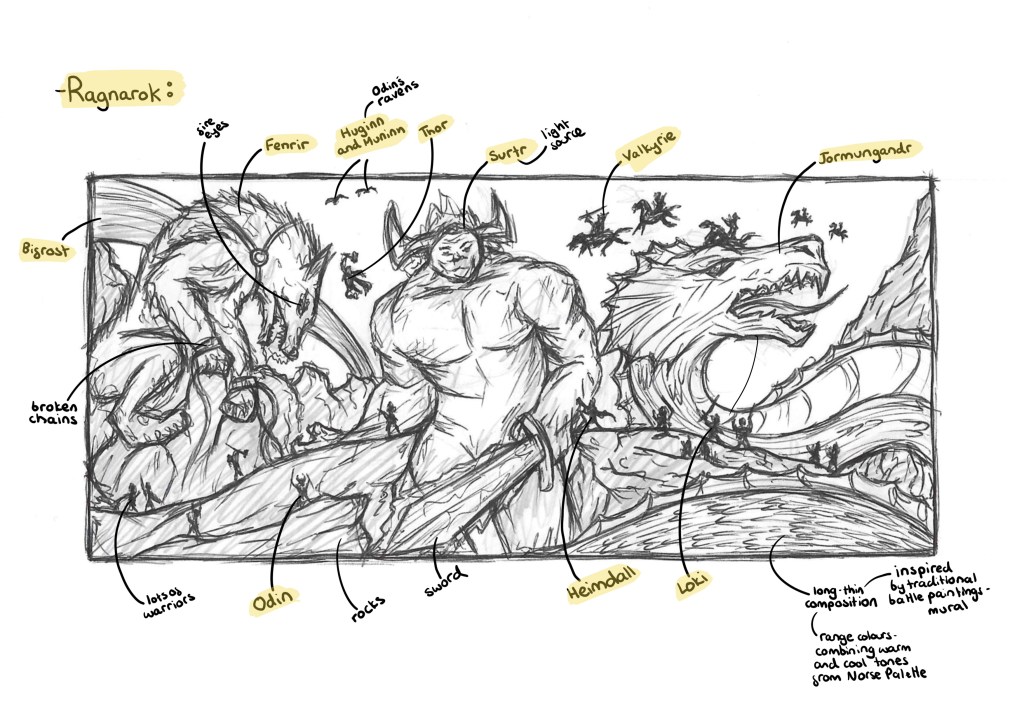
Ragnarok: this image tells prophecy of Ragnarok, meaning ‘doom of the gods’ in Old Norse. In the final battle the gods meet the giants, including Fenrir (left), Surtr (middle) and Jörmungandr (right). Norse mythology is a set of chronological tales, with Ragnarok making the end. On the left of the image is Fenrir who broke out of the shackles he was in on the other image. I have included details such as the broken chains and fire eyes. Fenrir battles Odin during Ragnarok so there is a silhouette of Odin holding his spear, behind Fenrir is the bifrost which is broken during Ragnarok. Fenrir is said to devour the sun so I have positioned him so he’s climbing up the rocks, ready to stretch out into the sky. In the middle is Surtr who leads the fire giants into battle. He wields a fiery sword which he uses to split the world. As a way of suggesting this I have a gap between the rocks that are in the foreground. Surtr will be the main light source of the image. On the right is Jörmungandr who has risen from the sea and spreads his venom over the land. Jörmungandr is said to grow and wrap around the world, I made him larger than the previous illustration so suggest this growth. Around the creatures there are lots of silhouettes of gods/goddesses. Some are random but others are specific characters including Thor, Loki, Odin, Heimdall and Valkyries. The colour palette I want is a combination between extreme warm tones and darker tones. The light and warmth comes from Surtr which reflects onto the surroundings and other characters. The image shape is long and thin, inspired by traditional battle paintings/ murals. Also I want to to be similar as the image of the creation story to act make the series feel cyclical and connected.

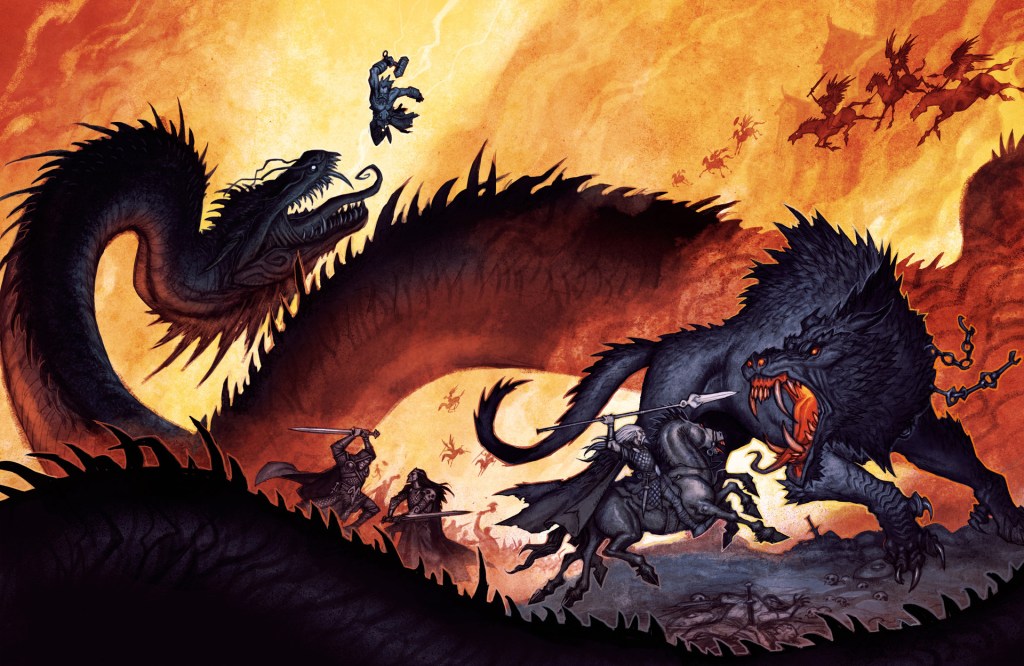
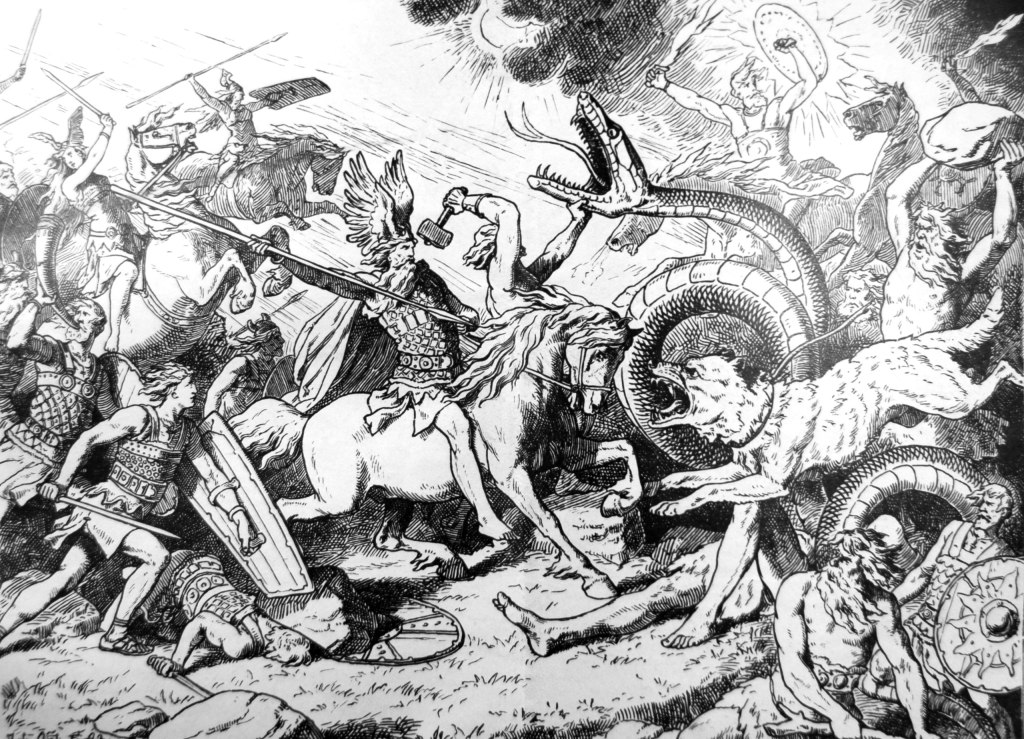
I was inspired by this style of image, depicting the battle field during Ragnarok. Some key elements I want to change are the scale and colour. I will make the creatures much bigger and more threatening. I want the focus of the illustration to be the creature, not the gods so I will make the gods smaller and just simple silhouettes. Also I want a full colour illustration to help show the intensity and drama of the battle.

Categories
Contextualised Practice Contextualised Practice: Project Level 5

Contextualised Practice: Project mediums

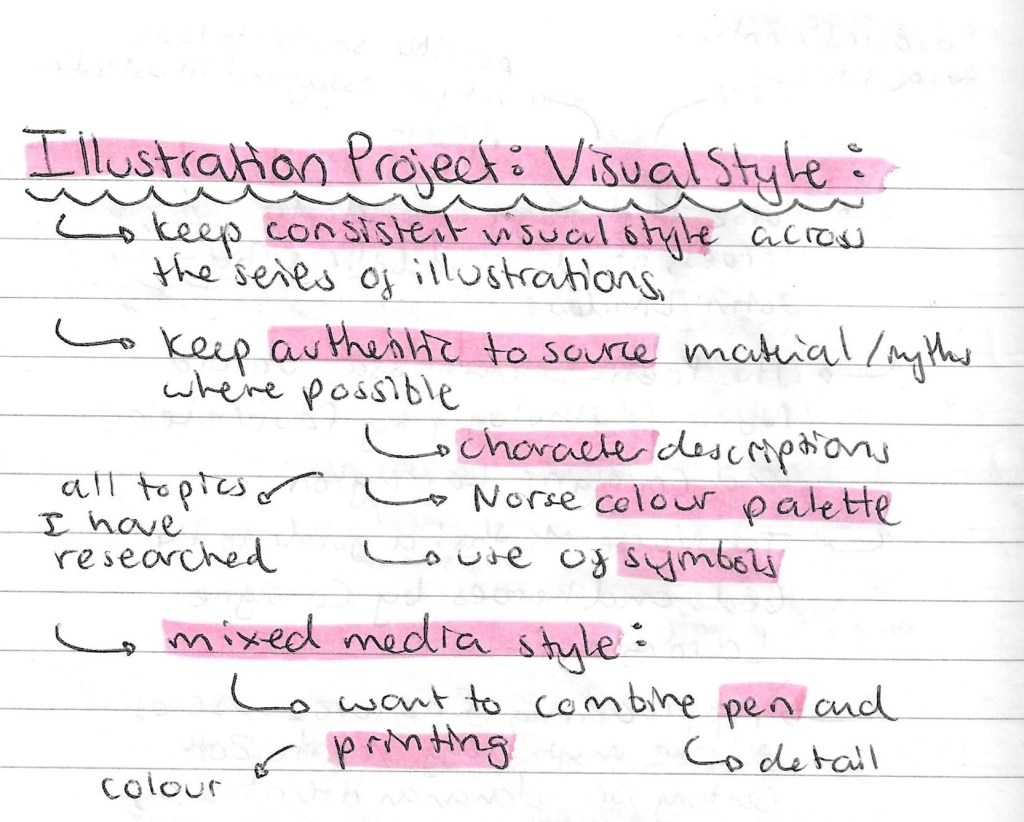
After extensive visual research I decided of what style and mediums I wanted to create my illustrations in. I want all the illustrations to have a consistent visual style, making them look like a coherent series. Through my research I found lots of reference images and want to keep my images authentic to the source material in regard to the character descriptions and colour palette. The style I have chosen is a mixed media, combining pen and printing. The combination of bright, bold colours with more intricate and fine details will help my work to appeal to younger and older audiences.

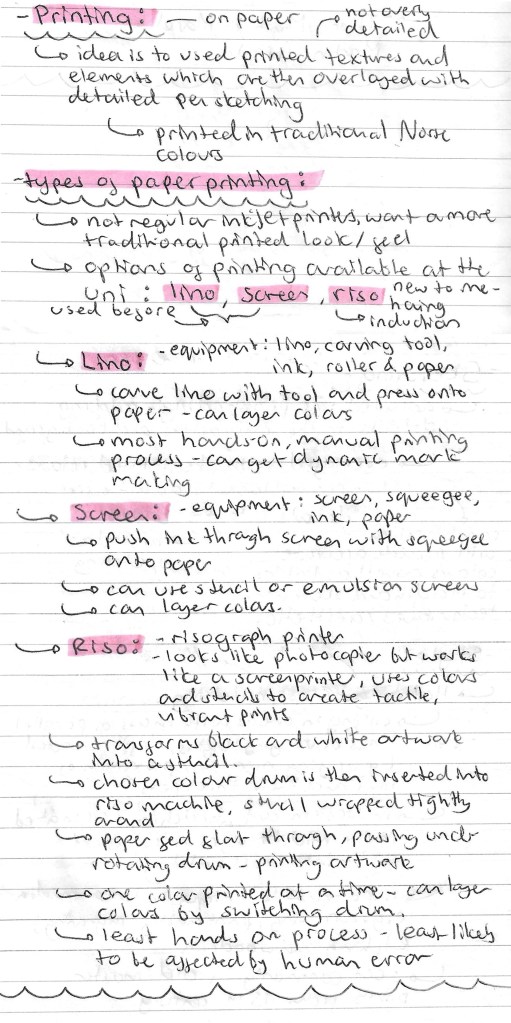
Printing: I want to experiment with printing for these illustrations. I plan to combine printed elements with pen sketching. The decision I needed to make was which type of printing to use. It would have been nice to be able to do hands on experiments with a range of printing styles but due to time constraints I needed to choose one. I want the illustrations to be printed on paper to achieve a more texture look. The 3 types of printing available at the University are Lino, screen and Riso. Below I made some notes about the basics of each type of printing:

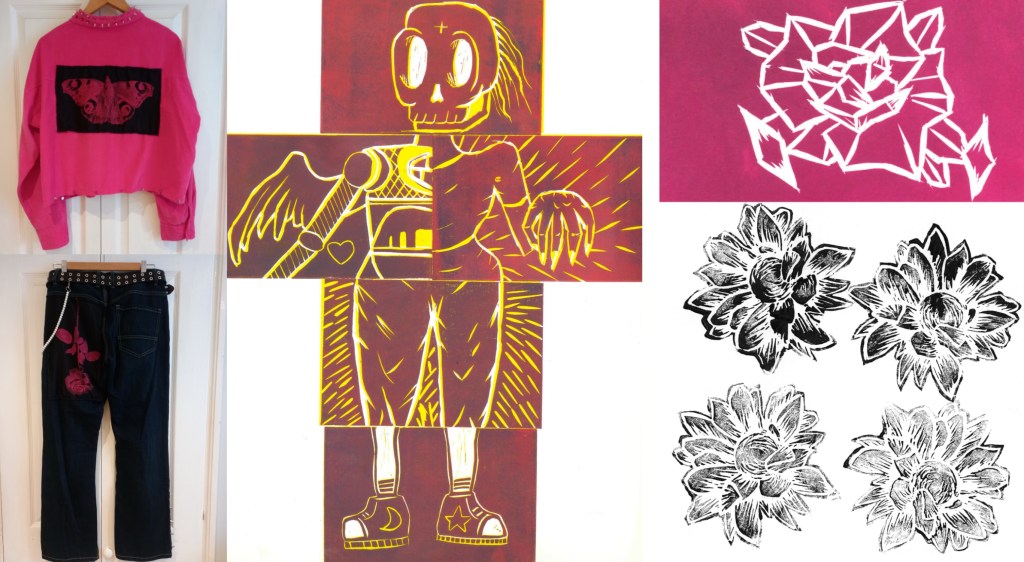
My previous work: these are some examples of my previous work that I’ve done using different printing techniques. Left- screen printing of fabric. Middle- screen printing on paper. Right- Lino printing.

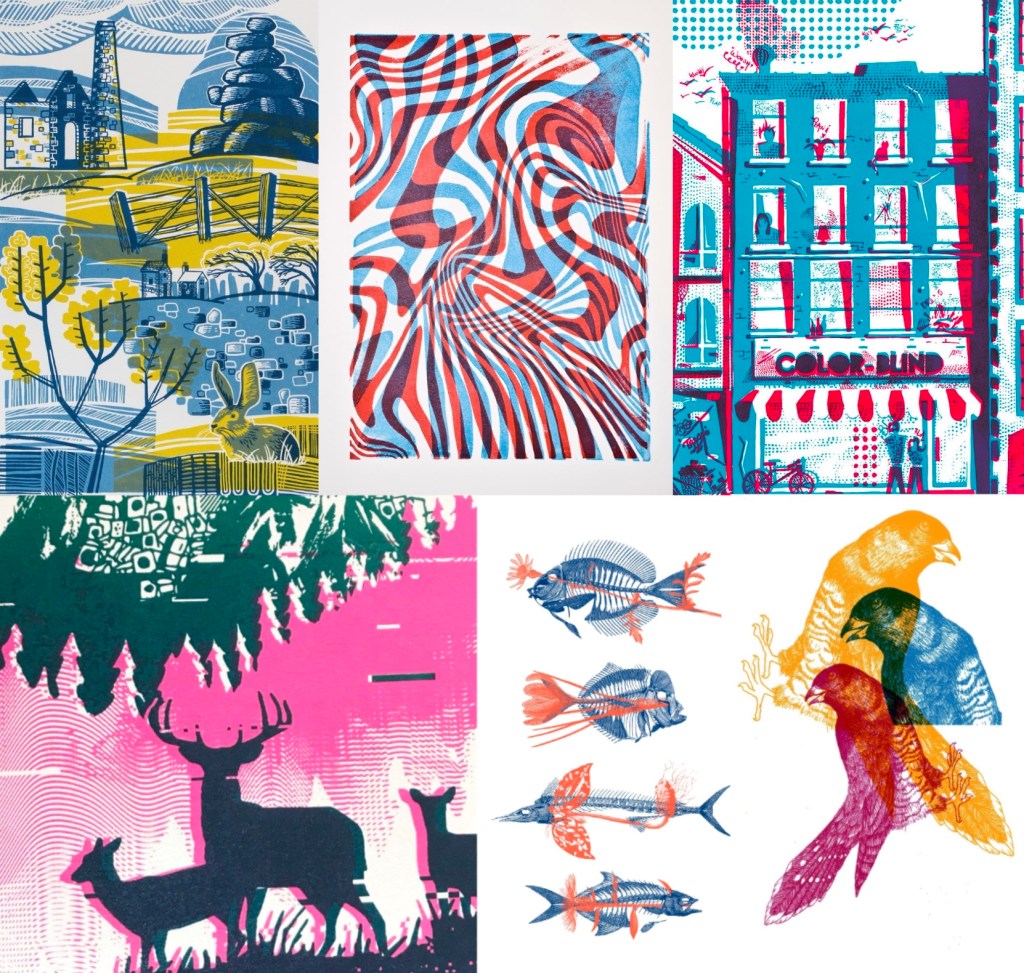
Lino Printing: these are some examples of Lino printing I collected when researching the style. This is the printing style I’m most familiar with having used it a fair amount before. I like the hands on nature and the imperfect dynamic mark making you can achieve when carving the Lino. Also it’s a good style for layering large areas of colour.

Screen Printing: these are some examples of screen printing on paper that I collected when researching the style. I have only done screen printing on paper once but have done screen printing on fabric a few times so I’m familiar with the process. This is a less hands on process but can achieve striking, overlapping layers of colour. Also you can create more detailed images easier with screen printing.

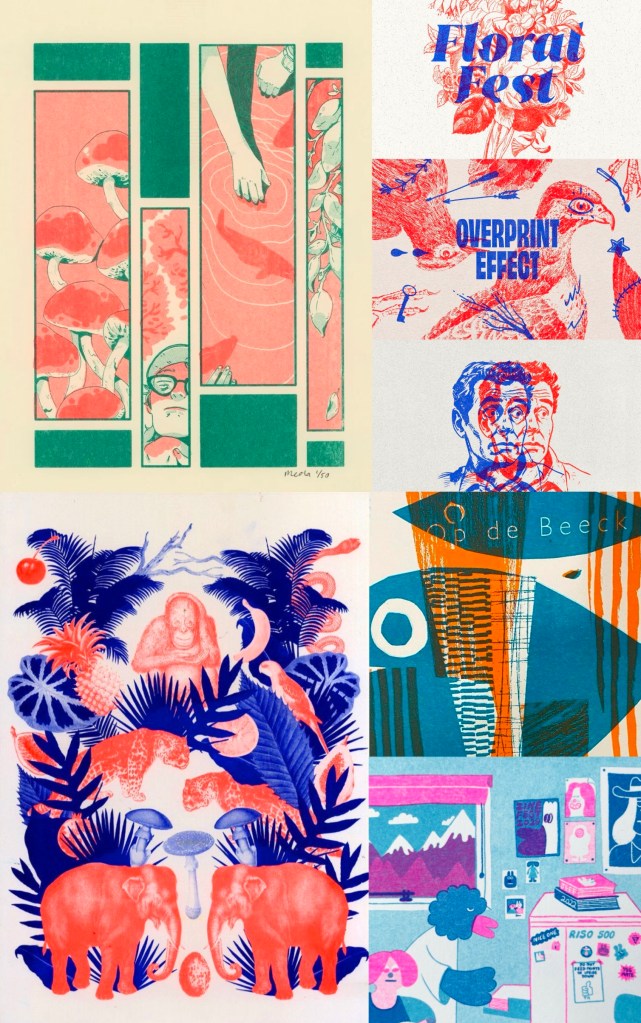
Riso Printing: these are some examples of riso printing I collected when researching the style. Riso printing is completely new to me, I have used it before so all my knowledge of it comes from research. Essentially Riso is an automated screen printing process that uses colours and stencils to create vibrant prints. In my research above I made some notes about the technical process. This is the printing style I have decided to go with. I want to use this module to explore a new technique so it is the ideal time to try Riso. Also it’s a quicker and more cost effective process than screen printing so I can produce more prints.

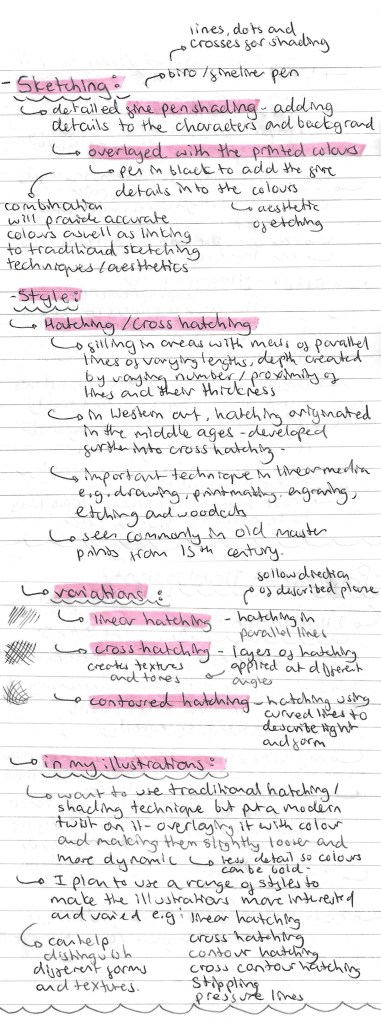
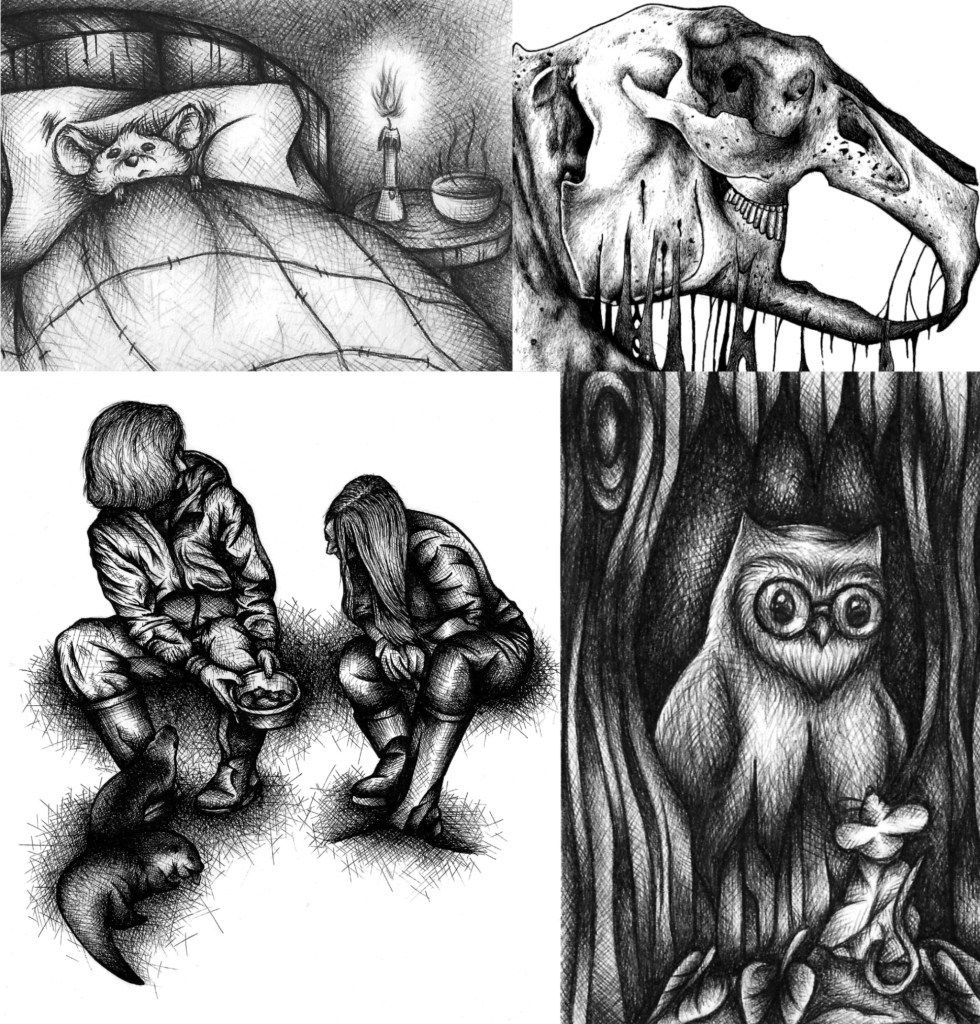
Pen: I wanted to combine the printing with pen, specifically a biro or fine liner. The pen will be used to add details and shading to the characters/ scenes. I’m not exactly sure at this point how I’ll combine the two mediums. Working with pen is something I’ve done a lot before and it’s one of my favourite mediums to work with. Below are some notes on my ideas for what styles of mark making I will incorporate into my project work:

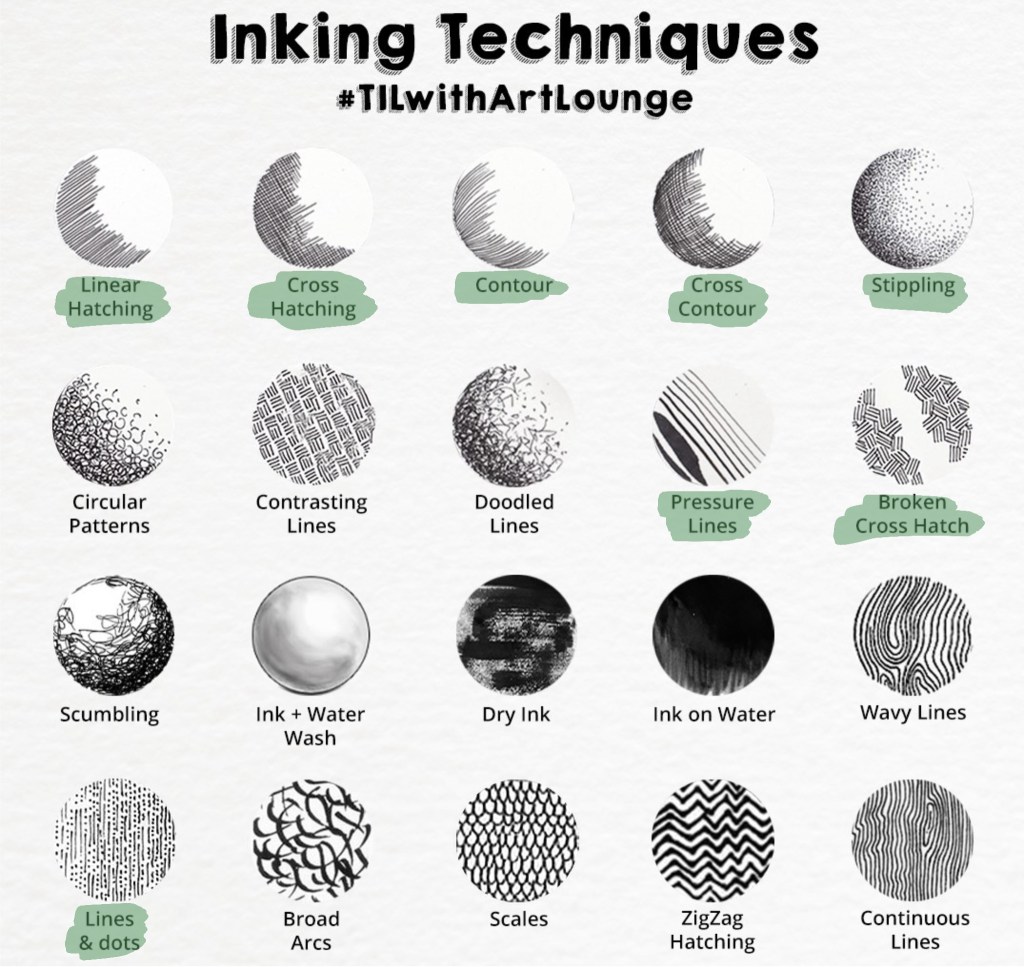
Here are a range of possible mark making styles I could use in my illustrations. The ones highlighted in green are ones I’d like to use. I plan to combine different techniques in order to make the shading more interesting and varied.

These are some examples of my previous pen work showing a range of different shading techniques including linear hatching, cross hatching, contour, cross contour and stippling:

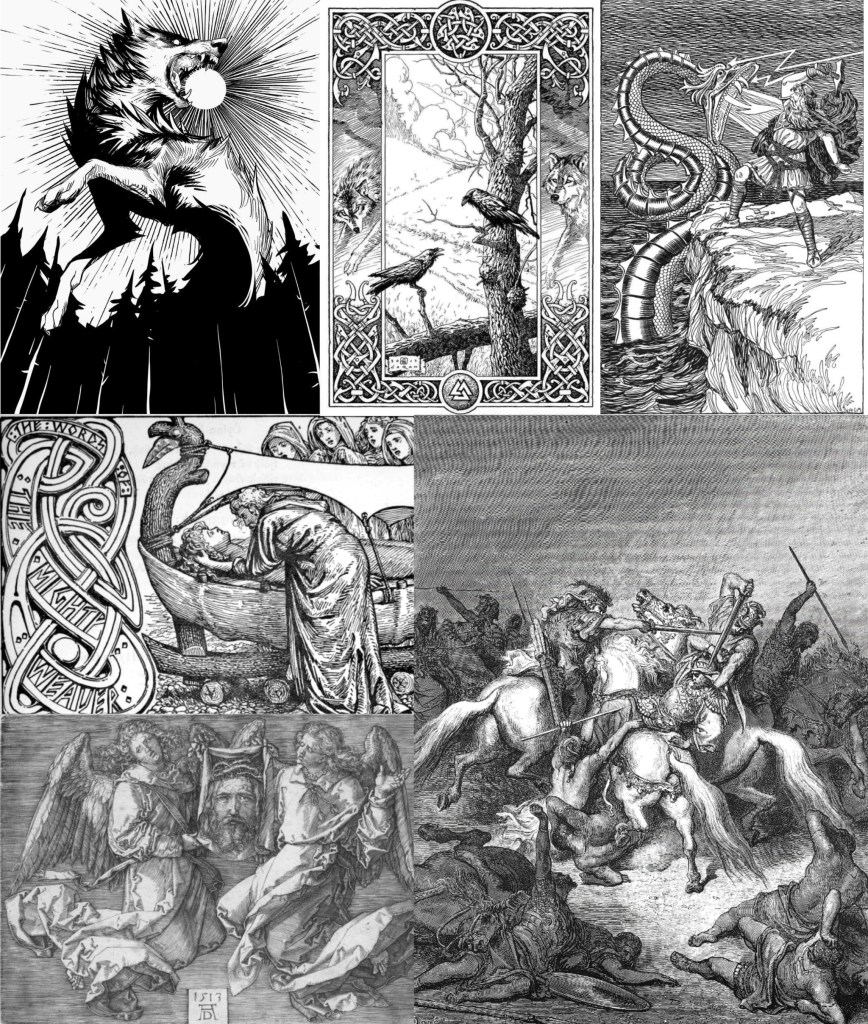
These are a range of artworks, primarily based around Norse mythology, which uses these styles of shading and line work that I can take inspiration from:

Project development:

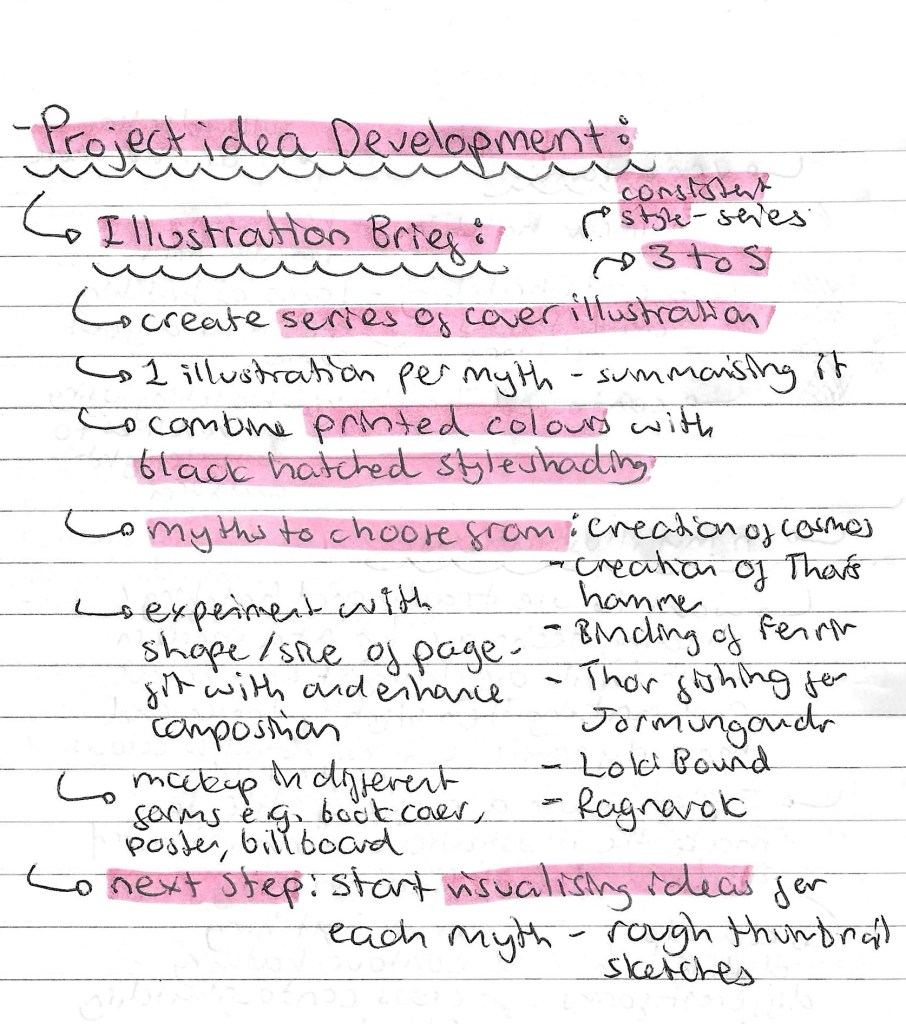
Here is my latest plan for the project:

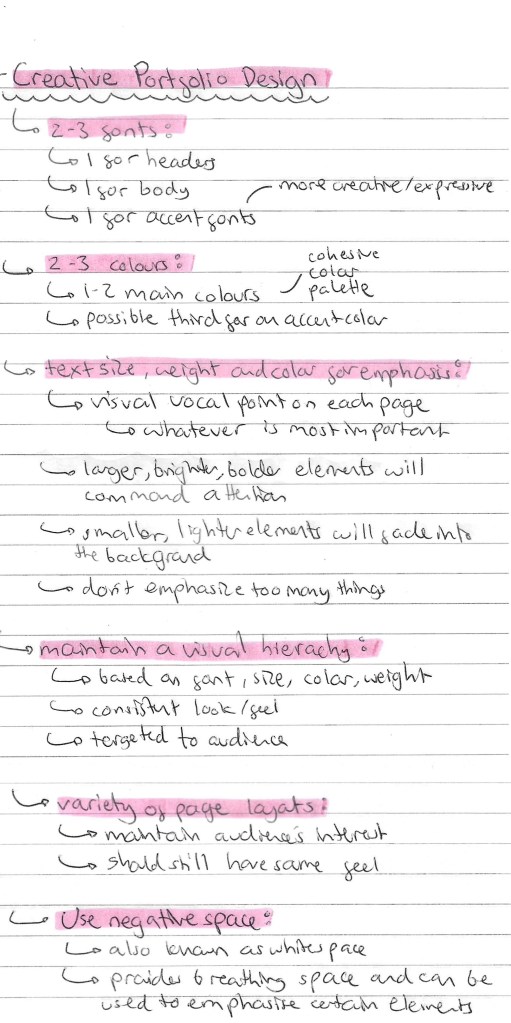
Some notes on making a creative portfolio that I can use and take into my own portfolio that I’ll be making at the end of this project. Some of the key points where using 2-3 fonts and colours, varying text size, weight and colour for emphasis and maintaining a visual hierarchy.

Here is my latest plan for the essay: